Olean’s weak anti-blight plan puts stress on rental housing

(Read the live link here at oleantimesherald.com) Published Nov. 19, 2017. Winner of New York State Associated Press Association investigative reporting, third place.

By DANIELLE GAMBLE and BOB CLARK, Olean Times Herald
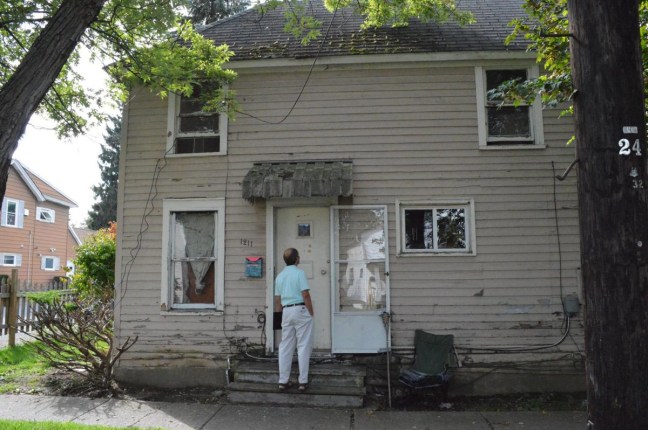
blight

Chris Stanley of the Citizen’s Action Network, a local activism group, goes door to door asking tenants to fill out anonymous surveys on housing conditions. The picture was part of an award-winning investigative piece on Olean housing conditions. (Photo by Danielle Gamble/Olean Times Herald)

OLEAN — At 220 N. Seventh St., the roof is broken in patches and the outside second-floor stairs wobble under one person’s weight. Bare light fixtures hang tenuously on loose planks inside the upstairs unit, close to where children are down for a nap. Downstairs, sunshine barely filters through unopenable windows covered in spray insulation foam.

“Complete violation,” declares Capt. Ed Jennings, head of the city’s code enforcement office, as he watches a video shot last June by the Olean Times Herald.

While silent video images play of exposed wiring in the living room, Jennings shakes his head in frustration.

“This is one of those houses that she just needs to kick everybody out and start over,” Jennings said.

City records show multiple citations since 2013 and attempts to require the owner, Linda Barlett of Olean, to make repairs. Some of them have been made.

Tenants said they need a place to live so they make some fixes themselves, but they are frustrated when the landlord makes minimal repairs. “It’s definitely not a mansion,” resident Kimberly Minton said, letting out a sigh. “It’s awful.”

Stemming blight in Olean is being undercut by the lack of inspectors, funding and local laws that would require landlords to bring units to code before they can be rented again. Such a law, the subject of a public hearing on Tuesday, is aimed at helping tenants like those who live at 220 N. Seventh and the thousands who live in the city’s 2,600 rental units.

Olean lags other cities its size in Western New York and Northwestern Pennsylvania that require regular inspections to fight blight.

Without such a law, Olean’s code enforcement depends on complaints from renters who have the sole power under state law to allow an inspector to enter their homes.

Neighbors call sometimes, usually to report outdoor problems. Complaints related to garbage, grass and snow account for about a third of the actions initiated by Jennings’s office since 2009, city records show. Only 8.7 percent of the actions are for housing issues.

“We don’t know where the problems exist,” Jennings said. “And some of these other occupants, they feel threatened by the owner if they call us, so we don’t get in these houses or they don’t call.”

The result is many renters living silently in dilapidated housing.

“Unfortunately, people who are in the lower income bracket who are forced to accept less-than-standard housing is kind of status quo,” said Stephanie Timblin, executive director of Olean’s Rural Revitalization Corporation, a nonprofit with a 30-year track record of helping owners fix up their homes.

While the city does have quality rental properties and excellent landlords, Timblin said, her office has responded to a range of complaints from poor weatherization to lack of running water.

“These buildings are not being kept up to code or up to the standards that seem very simple,” she said.

Olean’s housing problems have been discussed in city hall for at least a decade, but legislation has been repeatedly watered down or rejected. In 2010, a compromise led to a landlord registration law.

But talk about a law requiring inspections stalled.

That may change this year.

Alderman Kevin Dougherty, a homeowner and landlord, sponsored a property inspection law in May.

“I see other houses getting blighted out,” he said. “I watch other property next to me fall by the wayside.”

Dougherty said his proposal, which could come up for a vote as soon as Nov. 28, will motivate people to fix up their properties.

“I think the law is a good law,” said Olean Mayor Bill Aiello. “We’ve been talking about blight for years and years in Olean, and this will give us a start to bring our neighborhoods back.”

If the law passes, hurdles like funding and enforcement remain.

Even if tenants started reporting violations, Jennings said he doesn’t know if he has enough resources to respond. In 2015, Olean’s code enforcement office received 2,315 complaints, followed by 1,322 in 2016.

“You usually get a complaint on one thing and you get there and you find five other complaints or issues in the neighborhood,” he said.

As the city’s code enforcementsupervisor, Jennings has power over how much discretion to use when issuing tickets to landlords and how much time to give them to make repairs or evict the tenants. He said an order to remedy could have a timeline between 48 hours for something like garbage to a month for problems with the structure. Sometimes he warns a landlord about a violation instead of officially citing their property.

“If it’s a serious violation, we’re going to address it. But if it’s something that can get done over time and through negotiations with the owner or the occupant, we’d rather go that route than fine people. We’re not here to do that — we’re just here to get compliance and get Olean as a better place.”

Code enforcement, which is under the city’s fire department, has two staffers after a full-time position was cut. This year Jennings worked solo when his partner was on leave for five months. If the proposed law is adopted, the fees generated will allow the hiring of two part-time inspectors, Aiello said.

Lawmakers, tenants, neighbors and advocates say that unless solutions are enacted, properties that don’t meet state building codes will stay on the city’s rental market.

RENTAL DEMAND GROWS; BLIGHT SPREADS

Chris Labarge has lived at 220 N. Seventh St. for seven years, and Minton has lived there for four years. This summer, the space was shared by three adults, two children, three dogs and a group of cats.

“There’s only one door in and out,” Labarge said in a June interview, nodding up to the top of a worn wooden staircase. He was trying to repair the structure by nailing in new pieces of wood.

Shortly after, while standing at the top of the stairs, Minton said, “It’s going to go one of these days.”

City records show the property was inspected March 7, and Jennings issued a citation April 7 that ordered the stairs to be replaced within a week.

While watching video July 11 of the staircase’s condition in June, Jennings described the danger of it as “pretty severe.”

He subsequently revisited the property and found the stairs to meet “minimum standards.”

During a visit to the property Monday by the Times Herald, the stairs did not wobble under a person’s weight.

Barlett, who resides in Olean, declined multiple requests to be interviewed by the Times Herald.

North Seventh Street is a microcosm of the city’s housing woes.

Of the 12 properties on the 200 block of N. Seventh, half are rentals and three of those are owned by Barlett. Those three properties have been the subject of 17 code enforcement complaints between 2012 and Sept. 30, 2017.

On the five blocks of North Seventh there are 70 residences. Just seven of the properties generated 51 complaints in the last five years — three rentals, two city-owned, one owner-occupied and one vacant.

Residential blight stems from a decrease in homeownership and a drop in city population. Olean has lost 9,090 residents since the 1950s. Job losses followed, hurting the city’s economy and increasing the poverty rate to 23.7 percent, almost twice the nation’s 12.7 percent, according to U.S. Census Bureau statistics.

Olean simply lacks the population to fill its aging homes, and those who do remain may struggle to afford purchasing and fixing up a home.

“You see more and more people leaving the city, more and more houses sitting empty, more and more people renting,” said Common Council President Paul Gonzalez, D-Ward 3.

Blocks in Gonzalez’s ward have rental rates of more than 50 percent, such as several blocks near Franchot Park in South Olean.

Some of Olean’s housing problems stem from the age of the homes. Most are over 100 years old and not covered by the state’s most recent codes.

To assess the city’s rental properties, members of the Citizen’s Action Network activism group walked Olean’s most rundown neighborhoods last summer to distribute 400 surveys that tenants could fill in anonymously.

Only about a dozen people responded, said Chris Stanley, project leader.

“People are hesitant to complain because of fear that landlords will evict them, even though state law prohibits that,” Stanley said. He added many inadvertently open themselves to these circumstance by violating their lease agreement or paying rent late.

“There are people in our community who have needs and they don’t feel like they can speak up for themselves,” he said.

‘ALL OUT WAR’ AGAINST LANDLORDS

Dawn Shelley, of 1211 Washington St., said she is not afraid to speak out about the house she is renting from Richard Middaugh, of Alma, from whom she has rented multiple times before. Middaugh owns the most rental property in Olean, according to the city’s landlord registry.

The outside roofing is a patchwork of fractured tiles, and the basement floor is covered in puddles.

Middaugh did not respond to multiple requests for comment from the Times Herald.

Jennings, upon seeing photos of Shelley’s home, said the visible roof damage and some of the plumbing issues in her basement could result in citations for housing code violations.

Shelley thought so, too. So when she looked down the street and saw a code enforcement van earlier this year, she walked up to it and asked the officer to take a look at her property.

But when the officialgot to her door, Shelley said her wife stopped him.

“She didn’t want no problems with Middaugh,” Shelley said.

Code enforcement officers cannot enter a property without an invitation or a warrant unless there is an emergency like a fire. This invitation must come from the tenant, not the landlord, according to state law. Landlords cannot even enter their own property without tenant permission, with exceptions for emergencies or showing a house to prospective renters or buyers.

Of 2,658 rental units registered in Olean as of September, two-thirds listed owners with Olean addresses.

Middaugh reported owning nearly five percent of all rentals, the highest number of any landlord at 60 properties with 127 units. Barlett reported 26 properties with 42 units, the registry shows. Because landlords can face stiff fines for not reporting, officials say the registry lists nearly all rentals.

Both Middaugh and Barlett have a track record of responding in a timely manner to the multiple housing violations they have received on their properties, according to Jennings and City Attorney Nick DiCerbo.

“A lot of them, when pushed, will make the repairs or at least repair it enough that it meets code,” DiCerbo said. “It might not meet what we think should be appropriate. But most of the time, those landlords do comply with the orders. It’s just we have to hold their feet to the fire. And unless we get into a house we have no idea what’s going on on the inside.”

Andy O’Dell, who owns one Olean property but said he owns 80 throughout the Southern Tier, complained to the Times Herald that unruly tenants often damage properties and leave without paying utility bills. He called the city’s proposed rental inspection law an “all-out war” against landlords.

“We have no rights,” O’Dell said during a housing panel in October. “We can’t discriminate, we can’t evict, we can’t do nothing — they have all the rights.”

Jennings agreed that tenants are responsible for many of the problems he sees. He said some cannot afford to pay for garbage pick-up, while others are destructive and sometimes just “lazy.”

“Just because they are poor doesn’t mean they can’t be clean and take care of their property,” he said. “And that’s what we ask, and a lot of it is more of an educational thing for these tenants.”

But others place more of the blame on lack of oversight by both landlords and the city.

Robert Bliss, of 608 Irving St., has rented his property from Cornerstone Homes Inc. for about six years. He wants the city to enforce housing codes. He shouldn’t have to file a complaint to get an inspector, he said.

While he has a broken ceiling in his kitchen, he’s mostly concerned with problems outside — in his backyard sits a pile of siding he said has been there since he moved in.

“I’ve called (Cornerstone Homes) and they just blow me off,” said Bliss, 61.

Jennings, while reviewing a photo of the Bliss home, said he would ticket the person responsible for storing the materials in the yard.

After the Times Herald described the conditions of 608 Irving St., Angela Blodgett, Cornerstone Homes office manager, declined to answer questions on the record. She later issued a statement on behalf of the Corning-based company.

“We are all for rental inspections on a yearly basis to protect our tenants, but the tenants need to make us aware of repairs in a timely manner,” she said.

LOOKING FOR SOLUTIONS

Of 10 cities in Western New York and Northwestern Pennsylvania with populations within about 5,000 of Olean’s population, eight require residential rental inspections in some form. Officials in Batavia, Bradford, Pa., Canandaigua, Corning, Geneva, Hornell, Lackawanna and Tonawanda have passed laws over two decades.

“The concept of inspections has been discussed for years,” Gonzalez said, but during his five years on the Common Council, consensus has been hard to attain on inspections. “Right now, we have a council that fully supports this idea … Not everyone on the council agrees with every little detail of it — everyone on the council agrees that something needs to be done.”

The council is considering a proposal to inspect all city properties and issue a certificate of occupancy upon sale. The law would require inspections of all rental units upon vacancy before each unit is rented out again. It would take effect June 1, the beginning of the city’s next fiscal year.

Landlords who rent properties without a certificate of occupancy would be subject to fines from $250 to $1,000, or imprisonment up to 15 days for each day the property is rented.

Each inspection would cost $60 each, but landlords with high turnover would would pay $30 for follow-up inspections triggered by a vacancy within 12 months.

DiCerbo said he does not foresee any legal challenges that could be brought against the legislation, and credited the council for not writing in any exemptions which might have weakened its enforceability.

He added while it might take a while to “dig out of” the city’s blight issues, the new law will bring change.

“So much of the time, (council members) get beat up for not doing what their constituents want them to do or not listening to what people have to say,” DiCerbo said. “I think they did a good job this time, they thought it out and tried to balance the landlord’s rights, the tenant’s rights, the city’s rights to come up with a fair policy that applied to everybody.”

Stanley said the law as it is written would be a boon for the city as long as it isn’t “watered down” before it is passed.

Timblin said she believes the city has thoroughly researched the topic and hopes it will help low-income families.

“They have to do something,” she said of the council, “and I think the final legislation as it looks is going to be a great change in the status quo of the substandard housing that’s available.”

In the meantime,  Anthony “Tony” Ray, who also lives at 220 N. Seventh St., is worried that winter is coming and the roof needs replacing.

The city on Sept. 14 gave the owner 30 days to “remove and replace” the roof because it “has exceeded its life expectancy.” Work didn’t get started until the end of October and was shut down by the city on Nov. 15 because the workers were uninsured.

If the roof doesn’t get fixed, Jennings will issue the owner a ticket to appear in court.

“If the roof ends up leaking this winter, it will be subject to being posted unfit (for habitation),” he said.

Ray has little hope that anything will be done. “If it comes to that, I’ve got to figure something out.”

(This story was done in collaboration with Rose Ciotta of the Investigative Editing Corps.)

Drag Queen Kids Party brings wave of support to Olean library

(Read the live link here at oleantimesherald.com) Published June 21, 2018.

By DANIELLE GAMBLE, Olean Times Herald

OLEAN — Flo Leeta, covered in a sparkling white jumpsuit and a pastel wig swirled into a prominent unicorn horn, looked up from the book she had been reading — “Jacob’s New Dress.” She had just gotten to the part where Jacob was being told by his classmates that boys can’t wear dresses.

The Buffalo-based drag queen peered at the more than 70 children in front of her at the Olean Public Library with a thoughtful expression under her hot pink eyeshadow.

“There are all sorts of ways to be a boy,” she said. “Right?”

Rows of girls and boys, many dressed in princess or fairy costumes and crammed into the library’s Art Gallery, shouted back in agreement. Outside the gallery, more than a hundred parents and supporters who couldn’t fit into the space waited.

Flo Leeta entertained as part of the library’s Drag Queen Kids Party for nearly two hours Wednesday. She read two books and lip synced three times — twice to “Let It Go” from Disney’s “Frozen,” and also to RuPaul’s “Cover Girl.” She then gave a brief presentation about gender, during which she went through some history of feminine and masculine fashion and tried to explain concepts like gender fluidity.

“You know how water moves around and isn’t one shape? That’s how some people are,” she said, standing in front of a colored projection of “The Gender Spectrum.”

The event was part of the library’s efforts to highlight Pride Month for the lesbian, gay, bisexual, transgender and queer community. Flo Leeta answered questions as simple as how long it took to do her makeup — two and a half hours — and as complex as explaining what a bioqueen is — a drag queen who is a female, which is different from a man who portrays a woman as a traditional drag queen.

Afterward, a line formed as excited children, teens and adults waited to take their picture with Flo Leeta.

Nearby, Olean Public Library director Michelle La Voie was beaming, elated by the turn out.

“It was exactly like in our dreams,” she said of the community support.

For two weeks leading up to the event, library staff had received a lot of negative feedback online, on the phone and in person. They were also told there would be a protest at the event, which was supposed to include neo-Nazis — though none appeared to attend Wednesday.

La Voie said she and other library staff were initially very disappointed by the negativity surrounding their decision to host a drag queen event geared toward children, and she had been nervous things could get out of hand.

But her attitude was turned around by the dozens and dozens of supporters who showed up, and the cheers from children when Flo Leeta asked them if they wanted her to come back.

“It’s not even like my faith is restored — it’s like I have a whole other view of this community,” she said.

THOSE WHO CAME as supporters — who took up spots in front of the building as early as three hours before the event — chatted amongst themselves while wearing things like rainbow facepaint and pro-LGBTQ pins and T-shirts.

SaJean Webb, 17, came out with her family from Wellsville to support the library after seeing there would be protests.

“I have two moms and I do drag, and for me it’s like a huge thing for somebody to come into my life and say that’s wrong. Because it’s not — it’s just how we live our lives.”

Webb said she was happy to see the library host an event specifically for children with positive information about the LGBTQ community. To her, it’s a step toward helping people understand the life she and her younger sister have had.

“If you teach your kids that that’s wrong, you’re going to teach your kids to hate, and they’re going to grow up and hate, and that’s not OK.”

One of her moms, Danielle Freeman-Braven, said even as she has served on the board of the Olean-based LGBTQ group COLORS, she had never seen local people motivated to protest an LGBTQ event.

“(Flo Leeta) is just pushing for you to be happy and love who you are,” she said.

Though a Pennsylvania leader of the National Socialist Movement publicly stated the organization would be at the event, they did not appear to attend. Law enforcement and library officials also said they saw no protesters from the neo-Nazi group at the library all Wednesday.

The protests remained peaceful, which La Voie chalked up to the heavy presence of police and supporters. Roughly eight Olean police officers were present, including Olean Police Chief Jeff Rowley, as well as a New York State Police officer.

As officers patrolled, Olean Mayor Bill Aiello stood across the street from the library. He did not attend the reading, as he said he had family commitments, but added he stopped by beforehand in case citizens wanted to talk with him, as well as to “make sure this is going to be peaceful.”

At the northwest corner of the library, across the parking lot from supporters, a group of less than 10 protesters gathered with signs that included statements like “Leave our children alone!” and “Keep kids innocent.”

Protester Jonathan Smith, of Olean, asked why Flo Leeta was appearing in her performance attire and not as the male performer who brings her to life, Benjamin Berry. Smith wrote a letter to the editor to the Olean Times Herald against the library’s drag queen reading event, and said he was specifically against a publicly-funded organization hosting it.

“If you want to read a story book to children, come and do it,” he said at the protest. “But then he’s being political coming out as a drag queen and that’s already a sexual thing, so that adds a sexual flavor to the story book reading concept.”

He also said he felt Berry lacked any qualifications to host an educational event. When asked for his thoughts on Berry’s background in education — Berry, an Alfred State College graduate, has for years hosted events for children as a hula-hoop instructor and drag queen, and is a teaching artist with the nonprofit Young Audiences of Western New York — Smith said the concepts to be taught at the library event were too inappropriate for young children.

“Children don’t need to be exposed to gender expression — they’re children,” he said. “What does gender expression have to do with childhood?”

Pastor Rick Peters, an Olean preacher with the church God’s House of Refuge, said he protested the event because he believes the LGBTQ community represent a “sexual sin” that is “totally against God’s principles of life.”

“God loves them people,” he said, gesturing to the group of counter-protesters. “But that doesn’t mean their lifestyle is right. It’s wrong … I love them, I love the drag queen. That’s why I’m protesting — I don’t want to see anybody go to hell.”

On the other side of the parking lot, COLORS co-founder Alan Hadden also brought up religion.

“My thought is,” Hadden said, “God made us. If he didn’t want us this way, we wouldn’t be here.”

His husband, Dann Deckman-Hadden, the other founder of COLORS, said he was happy to be a part of the support for the event along with several local drag queens and drag kings. He estimated about 30 locals are drag performers.

Deckman-Hadden said the type of education provided Wednesday that normalizes the LGBTQ community is in line with everything his organization tries to do locally. His group is set to host a Saturday all-age drag show from 3 to 6 p.m. at the Loyal Order of Moose Lodge, 201 W. State St.

“What we do is not just for gays, lesbians, transgenders — it’s for everybody,” he said.“Also, gays and lesbians have children, too,” added Hadden.

Hadden said the highlighting of the LGBTQ community, especially during Pride Month in June, was just as important as highlighting other minority groups.

“If you had a black person in there talking about slavery, would (protesters) be here today?” he asked. “No.”

Deckman-Hadden said the concept that drag is inherently sexual comes from a prejudice that members of the LGBTQ community are more likely to have pedophilic tendencies — an idea that several institutions such as the American Psychological Association flatly reject.

“We are not sexual deviants,” said Deckman-Hadden, whose drag persona is Veronyca DeVaine-Paige. “Drag is a way of how people express themselves. It’s expressing their creativity and art.”

(Contact City Editor Danielle Gamble at dgamble@oleantimesherald.com. Follow her on Twitter, @OTHGamble)

Olean salon finds out the hard way NY salons aren’t protected from theft of services

(Read the original story at oleantimesherald.com. Published Jan. 21, 2018. To read the stories highlighting the changes to New York state law after the OTH story broke, click here and click here.)

By DANIELLE GAMBLE, Olean Times Herald

OLEAN — She said she didn’t bring enough cash with her.

“I had a bad feeling about it,” Leo Wolters Tejera said of his new client, who had received $130 of services Jan. 4 at his salon, WT Hair on North Union Street. He didn’t want to make her uncomfortable, so he let her leave without paying.

She was headed to the bank, he thought. He didn’t even ask her to leave collateral.

“I didn’t because why would I think that was going to happen?” he said.

“That” was a call to Olean Police Department after repeated requests from Wolters Tejera to get payment over five days. The salon owner, who has been operating out of his current digs with fiancé Elle Tejera since August, was frustrated he had to resort to calling the cops.

Frustration only grew when they told him state law doesn’t allow for salon customers to be charged with theft of services. The law that protects New York restaurants from dine-and-dashing also makes stealing services from taxis, theaters, telephone companies — even ski lifts — a crime. But because of how it’s written, it does not protect hair salons.

“Why is this any different from a restaurant?” Wolters Tejera exclaimed, lifting slightly out of his seat during an interview Tuesday. “You’re consuming something that we have to pay for. At a restaurant, you’re eating the food, so if you eat the food you can’t return the food and then leave.”

An amendment to the law that could extend protection to salons and barbershops is in committee right now in New York State Senate. But unless it is passed, businesses like WT Hair will remain unprotected from customers who don’t want to pay for services.

‘WE CAN’T BEND THE PENAL LAW’

After Wolters Tejera called Olean police, the responding officer called the client to encourage her to pay Wolters Tejera. However, police then called Wolters Tejera to let him know the payment issue was now a civil matter.

Olean Police Department’s Capt. Mike Marsfelder said Olean police could not bring criminal charges against WT Hair’s customer because “we follow what’s in the penal law.”

“I’ve been an officer 23 years, and I don’t recall this situation coming up,” Marsfelder said.

Cattaraugus County Sheriff’s Office Capt. Shawn Gregory, who has served for 27 years, said he also couldn’t remember dealing with someone refusing to pay a salon bill. But he became acquainted with the situation Wednesday when he reviewed charges against Samuel Victor Jr.

Victor, 40, was charged by the sheriff’s office with theft of services Monday and issued an appearance ticket for court after he allegedly left a Supercuts Hair Salon in Allegany without paying his bill.

After the Olean Times Herald called the sheriff’s office Wednesday questioning the charges, Gregory called back within an hour, stating the theft of services charges had been changed to petit larceny after consulting with the District Attorney’s office.

“Every now and again you have to make an amendment to charges,” Gregory said.

He said Victor leaving without paying for a haircut could be prosecuted as larceny under the “false promise” definition in Section 155.05, Subdivision 2D of New York’s penal code.

The code reads: “A person obtains property by false promise when, pursuant to a scheme to defraud, he obtains property of another by means of a representation, express or implied, that he or a third person will in the future engage in particular conduct… when he does not intend to engage in such conduct.”

Marsfelder declined to comment on the sheriff department’s specific case. However, he said not paying a salon bill would not count as petit larceny because “it does not involve property.”

“Don’t get me wrong, I don’t think it’s right to walk out and not pay your bill,” he said. “But with the penal law, we can’t bend the penal law in certain situations. Either it fits or it does not fit.”

Marsfelder added that in the future, salons that might find themselves in “circumstances exactly like this” would see their case “handled like this one was.”

ASKING FOR PROTECTION

Wolters Tejera said he has been wracking his brain to think about why salons and barbershops shouldn’t be covered under theft of service law. He can’t think of a reason.

“If someone is unhappy after we’ve done a full consultation… based off something we did incorrectly, I’m more than happy to fix it because obviously we want our guests to feel great about themselves after they leave,” he said. “But if they’re trying to get free service out of us or they got what they asked for and then they have buyer’s remorse, we can’t afford to foot the bill on that.”

Victoria Gayton, owner of Shear Passion hair salon in Olean, said she was shocked to discover that her salon wasn’t protected from theft of services.

Gayton has been a hairdresser for 18 years. While she said she has not personally had problems with clients paying, she hears “all the time” that other salons in the area have had clients’ checks bounce or had fake checks issued to them.

She said she hopes politicians would change the law soon.

“If I did have to deal with this personally, I would hope that the cops would back us up because it’s our industry, it’s how we make our paychecks to pay our bills, to feed our children, to buy our supplies,” Gayton said.

Tyrone Hall, owner of Hall of Fame barbershop on West State Street, said he felt bad for Wolters Tejera after Hall read over social media what happened at the salon.

In 17 years of doing hair, Hall said he’s had “several” people ask for a hairstyle and then refuse to pay because they say they don’t like the results.

“That becomes to me something that’s not right, but really, to kind of smooth and weather the storm, I’ll take a loss with that compared to getting in an argument or a fight with someone,” he said.

But he acknowledged for a new business, especially a salon, that approach isn’t as easy.

“I’m at $17, $20 a haircut, so I’m not going to lose my mind over someone (not paying), but… they’re service compared to ours — they would be at a larger risk than what a barbershop would be, just because of the time it takes to do something like putting a color on.”

Wolters Tejera said after another client in 2017 refused to pay a bill worth more than $100, he started giving clients waivers, which include clauses stating services will not be refunded and corrections are free only at the discretion of the salon owner.

“We didn’t get into this because we wanted to nickle and dime anybody — we got into this because we like people, we like hair, we like our community and we wanted to be a part of the growth of our community. But it’s scary,” Wolters Tejera said.

Wolters Tejera has a civil court date set for February. But civil court winnings are hard to collect — many websites dedicated to explaining proceedings even recommend retaining a lawyer who specializes in collecting settlements.

A LAW TO GIVE ‘PEACE OF MIND’

Marsfelder pointed out that New York law is specific to the types of services that can be stolen from, so it must be amended to include additional services. In New York, any business not listed under theft of services that has a customer refuse to pay cannot seek criminal charges against the customer.

Laws like those in Pennsylvania are much more broad. Penal law in that state use terms such as “labor” and “professional” to describe some of the types of services protected.

The reasoning for the newest New York theft of services amendment, as detailed on the State Senate website, states salons and barbershops have come under “significant financial stress” from customers leaving without paying for service, something that’s been exacerbated by the country’s economic downturn.

“This group of small businesses is no different than a supermarket or clothes retailer who would be able to bring a criminal prosecution for Petit Larceny against those who steal their products,” the reasoning reads.

Service industries that can be stolen from under the law include:

• Restaurants

• Hotels and motels

• Public transportation

• Cable TV providers

• Telephone or telegraph providers

• Utility providers who deliver supplies such as water or gas

• Equipment, facilities or labor owned by a commercial or industrial company

• Computer services

• Theaters hosting concerts or performances that require admission

• Ski lift operators

The bill would make salon or barbershop theft of services a violation for first-time offenders. Theft of services is often a class A misdemeanor, though offenses can range from a violation to a class E felony.

Bill sponsor state Sen. Marisol Alcantara, D-Upper Manhattan, said the amendment will bring “peace of mind” to shop owners.

“In my neighborhood, Washington Heights, hairdressers and salons make up a big part of the small business community,” said the Labor Committee chair in an email interview. “I was surprised to learn that the police cannot act when customers steal services, and I thought that should be addressed.”

Alcantara said the bill is moving to committee on Monday, and she is working to bring the bill out of committee and to the floor for a vote.

State Sen. Catharine Young, R-Olean, said she would support the bill because “businesses need and deserve recourse if they are the victims of theft.”

“Small businesses are the economic backbone of our communities,” she said in an email interview. “Throughout my time in public service, I’ve always been on the side of these hardworking New Yorkers. When people steal services from salons and barbershops, the impact to the bottom line is just as detrimental as when products are stolen from retailers’ store shelves.”

Wolters Tejera is hoping lawmakers will act on the support they have voiced.

“This amendment to this law is 100 percent necessary to protect us, especially as small business owners,” he said.

To view the bill or comment on it, visit www.nysenate.gov/legislation/bills/2017/S6343.

(Contact City Editor Danielle Gamble at dgamble@oleantimesherald.com. Follow her on Twitter, @OTHGamble)

Neighbors question nonprofit’s assistance of sex offender Robert Washington’s home

(To read the original, visit oleantimesherald.com. After this piece was published Oct. 1, 2017, Helen Washington was investigated for submitting false information on Home Energy Assistance Program and SNAP applications. She pleaded guilty in 2018 to welfare fraud and making a punishable false written statement.)

OLEAN — Along Fountain Street, tall trees and manicured lawns are graced with flowers, trimmed hedges and American flags. And, in the yard next to convicted sex offender Robert Washington’s house, two lawn signs together read “Sexually molest a child and you get your home remodeled for free!”

The signs highlight not only a simmering feud between Washington and several of his neighbors, documented in several Olean Police Department reports over the last two years, but also a debate the neighbors would like to have: Should nonprofit assistance funds for the impoverished be used to help those with a criminal history of sexual abuse?

Neighbors of Washington are voicing concerns that the home shared by the former Olean High School special education teacher and his elderly mother received apparent repairs and remodeling services this summer from local nonprofit organizations that use government funds.

Washington, 38, was charged in June of 2016 with having sexual contact with a 13-year-old male student during non-school sanctioned tutoring sessions at both Washington’s 361 Fountain St. home and the victim’s home. He was fired by the Olean City School District shortly after.

Neighbors are questioning why taxpayer-funded programs were allowed to benefit Washington, who is currently serving a six-month sentence in Cattaraugus County Jail for a third-degree criminal sex act, a class E felony, and set be released in December.

“He’s sitting in jail for molesting a child and he’s going to come home to a brand new, remodeled house that the taxpayers paid for,” said Barbara Whiteman of 371 Fountain St., in whose yard the signs about free remodeling were posted. “Does that sound right to you?”

Washington’s Buffalo-based attorney Frank Housh said Washington is entitled to all rights except those forfeited as part of his sentencing, and that the neighbors’ argument is “not legitimate.”

“They don’t get to decide who gets the benefits of being a citizen in the United States and in the city of Olean,” Housh said. “The mob doesn’t get to decide which funds are available and which ones aren’t.”

When contacted by phone Friday, Washington’s 74-year-old mother, Helen Washington, said she received home improvements from local organizations, but that it was nobody else’s “business” what those improvements were and how much they cost.

“I was a single parent and I worked hard,” she said. “I didn’t have the extra cash to put into my home and these people have offered to do it.”

The nonprofits in question — Cattaraugus Community Action, Inc. and Chautauqua Opportunities, Inc. — both declined to say whether they provided any free or reduced-cost services to the Washingtons through their various housing improvement programs, citing confidentiality reasons. However, they added that eligibility requirements are set by various state and federal guidelines, not by the individual organizations.

Fountain Street residents say if that’s the case, state and federal guidelines need to be changed.

“Maybe there are rules (the nonprofits) have to follow and they couldn’t say no,” said Carrie Peters of 360 Fountain St., who lives directly across from the Washingtons, “but if that’s the case, our legislators need to know that this is not OK. It is not OK to spend our money on people like this.”

Home improvements

The collection of neighbors who reached out to the Olean Times Herald with their concerns include Whiteman, Peters, Todd and Janice Randall and Matthew Sage. In a group interview Aug. 30, they reported witnessing the Washingtons’ home receive several visits from vehicles with Cattaraugus Community Action and Chautauqua Opportunities insignias, and subsequent repairs that began in mid-August and wrapped up about a week and a half ago. They said those repairs appeared to include new windows, subflooring and installation, and that a new hot water tank was delivered to the home.

Both organizations provide home repair, as well as energy-saving and weatherization renovations to low-income people. Josiah Lamp, director of housing and community development for Chautauqua Opportunities, based in Dunkirk, said the organization tries to coordinate with Cattaraugus Community Action “as much as possible” to provide housing services in Cattaraugus County.

Both Lamp and Cattaraugus Community Action CEO Tina Zerbian declined to say if and what services the Washingtons received.

“All services that our agency provides to anyone in the community are held in confidence,” Zerbian said in an email.

Nonprofit agencies — even those that use government funds — are not subject to Freedom of Information Law or Freedom of Information Act requests.

Helen Washington said she applied for improvements, not her son, and they were for her benefit, not her son’s. Housh noted Helen Washington has not committed any crime and is entitled to whatever funds are legally made available to her, private or public.

However, both Washington and his mother are listed as owners of the property on Cattaraugus County Office of Real Property data and the city of Olean’s 2017 assessment roll. Officials with the city Assessor’s Office said, according to their records, Washington is the remainder of the property’s trust, meaning he will own the home when his mother dies.

“It’s mind-boggling that he’s sitting in (jail) and their property value is (increasing), meanwhile we surround them and our property value is (declining),” said Todd Randall of 341 Fountain St., whose property borders the Washingtons’.

“We’ll never be able to sell our house,” added his wife, Janice Randall.

Their concerns are valid, according to a study published by the American Economic Review in 2008. The study states houses within one-tenth mile of a sex offender’s home drop 4 percent in property value, while houses directly next to an offender’s home sell for about 12 percent less.

Washington was rated as a Level 2 sex offender during a Sex Offender Registration Act hearing last month, meaning his name and complete residence address are available on the state’s public registry.

Changing the policy

The county’s Community Action agency is a subsidiary of New York State Community Action Association. The state association’s website describes these agencies as “federally designated … frontline resource(s) for people living in poverty.”

Eligibility criteria for assistance programs are sometimes based solely on household income and are established on a case-by-case basis by the organization’s various funders, Zerbian said. Those funders include the Cattaraugus County, New York state and federal governments, as well as private entities.

For example, Cattaraugus Community Action received a $750,000 grant earlier this year from the New York State Division of Housing and Community Renewal to expand its weatherization and energy conservation program.

“We cannot withhold services from eligible clients based upon whether we, or anyone else, deems the client worthy above and beyond the eligibility criteria,” Zerbian stated. “ … Our mission is one of an anti-poverty organization. As such, we do not specifically outreach to persons with criminal backgrounds, nor do we typically deny services based solely upon a criminal record, although there are exceptions.”

Lamp gave a similar explanation in an interview Friday.

“Everything would need to be done in accordance to the law or specific regulations of a particular program,” he said.

Housh said if Washington’s neighbors take issue with the home receiving services, they should “seek remedy in the law.”

Todd Randall said he and his neighbors have reached out to local lawmakers, but many of them have not reached back. He believes some are “trying to bury this” because of the uncomfortable nature of the topic and because it could involve taking away resources from impoverished people.

“Regardless, it’s going to mean someone looks bad,” Randall said.

One of the lawmakers who did get back to them was a fellow Fountain Street resident, Cattaraugus County Legislator John Padlo, D-Olean.

Padlo said he spoke with Cattaraugus Community Action on behalf of his neighbors and was told the Washingtons qualified for the services they received; he said he has not heard of the Washingtons receiving services through Chautauqua Opportunities.

“Do I agree with it? No, I don’t, but if they fall in the criteria then they qualify for it,” he said. “I know what their point is: that there’s a convicted felon there. But Community Action’s point of view is those people qualify for it. They can’t discriminate.”

Padlo added that it’s his understanding the funds used to repair the Washingtons’ home came from the state and federal government, not Cattaraugus County. The majority of public funds received by Cattaraugus Community Action is from the state and federal government, said Padlo, adding the county sometimes acts as a “pass-through agency” for state and federal funds.

“Once we receive the money, we in turn pass the money through Community Action. Even then, the eligibility requirements can’t be changed or altered (by the county government),” he said. “Obviously, if it’s a law that can be done at county government, I’d certainly look into that.”

Neighbors said they are not against impoverished people receiving government assistance. They are concerned about the right people getting it.

“We don’t have anything against the volunteers for this community, the people who are working for it — it’s the rules on the process of the application and who they’re allowing to take this money,” Peters said.

A history of disputes

Helen Washington said she has lived in her home for over 50 years and never bothered anyone. She finds her neighbors’ issues with her home repairs “ridiculous.”

“I don’t think (my neighbors) should have their nose in my affair,” she said. “Every time I get company, or somebody is at the door, they run right out to see what’s going on.”

Olean police have responded to the Washingtons’ home for reports of neighbor disputes at least 10 times over the last two years, according to incident reports obtained by the Times Herald through a FOIL request.

The calls, made both by the Washingtons and against the Washingtons by their neighbors, mostly the Randalls, include complaints about loud music and plowing snow onto each other’s property. In two reports — one occurring just days after Washington’s arrest in June 2016 and the other a day before his sentencing in June of this year — neighbors allege Washington took cell phone pictures and video of them and their home. During the June 25 incident, Peters alleges Washington took pictures of her 5-year-old daughter playing in front of the house.

No one has been charged in any of the incidents.

Shortly after Washington’s arrest, neighbors who spoke with the Times Herald planted several signs on their own lawns that read “No excuse for child abuse” and “No pedophile zone.”

Neighbors said their signs are up not just to slam Washington.

“When (Washington was first arrested), we were more concerned that if someone were to take action into their own hands, are they going get the right house?” Peters said. “We were more concerned about our own safety.”

No incidents of vandalism to the Washingtons’ home have been reported, according to the police reports.

Housh considers the signs “harassment” and “vigilantism.”

Olean Police Chief Jeff Rowley said because the signs are not vulgar or threatening, they don’t break any laws.

“At least the signs that I saw, I really don’t have the authority to make them take them down or cover them up,” he said.

Housh said Olean police have failed to address neighbors’ alleged harassment of the Washingtons with the signs and ongoing neighborhood dispute. He said he has sent a letter about Olean police’s alleged lack of response to Rowley, Cattaraugus County Sheriff Timothy Whitcomb and New York State Police Superintendent George Beach, but heard nothing in response.

“At least according to my client, the Olean police are doing nothing, and by doing that they’re encouraging this kind of vigilante behavior,” Housh said.

Rowley said Olean police always respond when called by the Washingtons or their neighbors, and to say otherwise is inaccurate, noting he personally went to Fountain Street in the spring to listen to the Washingtons’ allegations.

Rowley said it’s difficult to press charges in neighbor dispute incidents, as offenses don’t necessarily warrant a charge, and often “something that may be annoying to you may not necessarily be illegal.”

“We’re just kind of hoping it resolves itself, and everybody grows up a little bit and leaves the other person alone,” he said.

Todd Randall said Housh’s accusations of vigilantism are an effort to deflect Washington’s guilt, adding that neighbors have never had a physical altercation with Washington.

With him being a softball coach at St. Bonaventure University, and his wife an owner of a Farmers Insurance agency, Todd Randall said he understands the public scrutiny that comes from pushing this issue and is not trying to be “inflammatory.”

He said his issue with the Washingtons was indeed the catalyst for his interest in this topic and “to pretend it didn’t start with them would be disingenuous.” But after several conversations with his neighbors, Randall said the concern among the neighbors expanded to a moral question.

“I keep thinking back to the victim,” said Peters, an OHS math teacher. “To see that the person who did this to you is sitting in jail but then getting all of these things done at their home — what are we teaching that child? That somebody can hurt him and then get free stuff?”

As far as the scope of what crimes should necessitate nonprofits to refuse services, Todd Randall has no answers, conceding that “everything is not black and white.”

“All I know is I’m looking next door and you’ve got the worst of the worst,” he said.

(Contact reporter Tom Dinki at tdinki@oleantimesherald.com. Follow him on Twitter, @tomdinki. Contact City Editor Danielle Gamble at dgamble@oleantimesherald.com. Follow her on Twitter, @OTHGamble.)

Trustee chair grilled by Faculty Senate

Read the live link here or a PDF of the print version here.


Tension erupted at Tuesday’s Faculty Senate meeting as University of Toledo Board of Trustees Chairman William Koester fielded questions for over an hour about faculty workload changes, the university’s deficit and administrative salaries.

Faculty workload has been a hot-button issue since administrators proposed reducing part-time faculty, increasing class sizes and cutting back on research that isn’t funded by outside sources. The proposals are part of “Imagine 2017,” UT’s main campus five-year plan.

For more information on the provost’s five year plan, visit the IC’s online resource for ‘Imagine 2017.’ 

Koester said the trustees are “trying to do what we believe is best for the university and its staff.”

But Andrew Jorgensen, associate professor of chemistry, said the suggested cuts to unfunded faculty research will alter the university “from the top in a way that would be very hard to recover from.”

“We’re making a dramatic change over a short period of time, and frankly, it’s informed and directed by leadership that doesn’t have the experience of leading the academic mission of a major university, as respected as those individuals may be,” he said.

Koester defended asking professors to focus on teaching rather than research, saying it would “go a long way in helping control some costs.”

“We’re not saying that you shouldn’t be doing research; we’re looking to see if we can improve that efficiency,” he said. “You professors are our best teachers and to some degree, are we keeping our best teachers out of the classroom?”

“Doing research doesn’t mean we aren’t teaching,” replied Patty Relue, associate professor of bio-engineering. “Doing research is a different kind of teaching because you’re usually working with graduate students.”

Amy Thompson, associate professor of health education, said students will be further hurt by recent changes to student services. She cited the elimination of director positions for the Sexual Assault Education and Prevention Program and the Alcohol, Tobacco and Other Drugs Prevention Program, as well as an increased emphasis on peer education.

“People are saying, ‘Well, we can provide that with peer education,’” she said. “Really? We’re going to have a student take another student to get a rape kit? Or really, we’re going to have another student go and do alcohol education and it be effective?”

In a January interview, former Dean of Students Michele Martinez said the goal for the new SAEPP is to have at least one employee from every college volunteer to become trained “first responders.” Those with more professional training who can lead victims through recovery and legal processes will be employees of the Counseling Center.

Koester said that because of budget constraints, the university is facing limited options.

“We want to do everything,” he said. “I would love to do everything, but we are limited to the resources we have, and we have to work with the resources we have to try to provide the services that we want.”

When Koester asked the senate to tell him if they felt the administration had misspent any money, Associate Professor Sharon Barnes of the women and gender studies department questioned Provost Scott Scarborough’s salary and bonus.

Scarborough’s salary, which the board approved on Sept. 17, is $389,000, not counting scheduled bonuses. The provost received a $100,000 bonus in December, and is set to collect two additional bonuses of $75,000 in June 2015 and June 2017.

Koester said the board does not “exercise direct authority” over President Lloyd Jacobs’ hiring choices.

“My guess is he believed that this is what he needed to pay to the provost that would be competitive with what he saw in the market place,” Koester said.

Applause broke out after some faculty comments, including when Thompson questioned several administrative decisions and spending choices.

“Why are we being forced to teach more and do the work when people are getting bonuses and getting raises that we don’t have?” she asked. “I don’t mind taking one for the team; I don’t mind teaching more if I have to. But let’s all take the load, not just the faculty.”

Koester said the plans are meant to avoid layoffs, citing Bowling Green State University’s plan to cut about 100 faculty positions this year.

Koester said the university is “maxed out” on the amount of tuition it can charge students, and the board is being pushed by the state to increase workloads.

“From the top down, we’re seeing pressure that we think we have to address,” he said. “We don’t think we can continue to raise fees to cover additional costs.”

“If we can fix the problem now, we can maybe later save ourselves from some government bureaucrat coming in and forcing changes on us,” he said.