
A year after heroin: One Olean family’s tragedy, a nation’s epidemic

(To read the original story, visit oleantimesherald.com. Published June 10, 2018.)

OLEAN — As a group of family and friends gathered fistfuls of balloons to release into the sky above War Vets Park on Tuesday, Karen Materna was still scrambling a bit.

“Don’t let them go yet,” she called out. “I’ve got to finish this note.”

The note, written on yellow paper, was for her son Mathew Chaffee, on the one year anniversary of his death.

Chaffee died June 5, 2017, one among a string of Olean men who had overdosed within a days of each other. Those deaths sparked a vigil that brought 300 people to Lincoln Park, which included a makeshift memorial of photographs of those that have died from addiction, as well as a release of orange and purple balloons.

On Tuesday, a memorial of photographs were again hung, and balloons — red and black — poured into the sky.

“I love you baby,” said Chaffee’s mother, softly, as she watched her note float toward the heavens. “I love you, Matty Matts.”

Through this ritual, his family hopes to keep a piece of Chaffee alive, as well as remind Oleanders that addiction in the community still needs to be addressed.

Meghan Materna, Chaffee’s younger sister, said it’s been a rough year for the family, which includes her mom and her younger brother Michael.

“We’ve just been trying to push through it,” she said. “It’s still surreal to us. He was a great person and he had three beautiful kids, so we just want to keep his memory going … I want to do this every year for him.”

The tight-knit family seems to get through some of their struggles by supporting each other and remembering the good things — like Chaffee’s love of the rapper Eminem, and his great sense of humor. And they celebrate the legacy of his children — Amara, age 11, Alayna, age 6, and Peyton, age 6, who Materna said is the spitting image of his dad.

Meghan in particular holds on to the number 29, which signifies both the age of her brother at his death and  “guardian angel,” according to Pastor Tyrone Hall of the Lighthouse Church in Olean, who presided over her Chaffee’s funeral.

“We call him our Angel 29,” she said. She has clothing where Angel 29 is emblazoned, as it was on his park memorial.

But his family all miss the simple things. Karen Materna still wishes she could do her son’s laundry, especially if that meant seeing him burst through her door with his loud, teasing jokes.

“It’s hard. It’s hard as a parent because,” Karen paused, tears coming to her eyes, “your kids aren’t supposed to go before you.”

WHILE THE DEATH toll of last year still looms over the community, officials said opioid overdose statistics seem to be leveling off.

There were a total of 11 heroin overdoses that lead to death in Cattaraugus County in 2017, according to provisional statistics from the county Department of Health. Before then, there were 10 deaths in 2016. The state’s department also registered 11 heroin/opioid overdose deaths in 2015 in the county.

Compare that to the three opioid overdose deaths that have been counted so far in 2018, according to Dr. Kevin Watkins, director of the county health department. Watkins said on Friday he had that day received another death certificate from January that showed fentanyl was the cause of death in one more county resident.

“That’s still three deaths too many for us, because these are preventable deaths,” Watkins said.

However, he also finds promising that the use by EMS, fire and police of the overdose antidote Narcan has also dropped. Narcan usage in 2015 was 42, climbing to 68 in 2016, down to 45 in 2017 and only 13 so far this year.

Also, as the county has pushed Drug Take Back Day events, Watkins said they have been collecting “hundreds of pounds” of extra prescription drugs. He also noted more drug providers are getting trained on cutting back opioid prescriptions, and local rehabilitation services are using medication-assisted treatment therapy more often for opioid users, which he said is far more effective for recovery.

“This is all helping us,” he said.

Watkins has been immersed in the topic since the county’s heroin/opioid task force was formed two years ago as heroin overdose deaths in the area were spiking. The group is comprised of more than two dozen agencies, including law enforcement, medical personnel, nonprofits, family members of addicts and former addicts.

It’s been at that task force were he has heard positive reports from the Southern Tier Regional Drug Task Force about pulling more heroin and other drugs off the street, and from the Council on Addiction Recovery Services (CAReS) as members build a new facility with 20 treatment beds in Westons Mills in addition to their adjacent 16-bed CAReS treatment facility for men.

“We really do feel a lot more positive now,’ Watkins said of the task force. “At one point, we couldn’t even find a rehab center for someone in the community.”

However, Watkins said he cannot clearly point to which of these efforts is making the biggest difference. His reasoning is all speculative.

There could be more fear-inducing factors at play, too.

Last year the Cattaraugus County District Attorney’s Office for the first time ever charged dealers with users’ deaths, including three Olean women with criminally negligent homicide, a class E felony, for allegedly selling fentanyl-laced heroin to three users who later fatally overdosed. Only one, Chelsea Lyons, 27, was convicted. She was sentenced in June to one to three years in state prison for her role in 42-year-old Matthew Harper’s February 2016 death.

Another deterrent could be the increase of heroin-laced fentanyl — the opioid responsible for most overdoses, as it can be 50 times more potent than heroin. However, Watkins offered that anecdotally, a user on the taskforce said education on fentanyl might not actually be a deterrent, as it would make them chase after the drug harder to feel a stronger high.

“We’re not sure of why we’re seeing the leveling off of opiod deaths in the county,” he said.

THE FAMILY KNOWS where Chaffee’s addiction started — a severe car accident at age 24.

“He ended up breaking the bone that connects your head to your neck, and a lot in his jaw,” Meghan Materna said. “We almost lost him then.”

He was prescribed opiods to handle the pain, and his mother said that first dose spiraled into him wanting “more and more and more.”

“I called his doctor and I said, ‘You give my kid pills again, I’ll report you.’ Because I didn’t want to have them any more,” Karen Materna said.

Cattaraugus County has one of the highest rates of opioid prescription in Western New York.

But later, she realized without a prescription, Mathew began turning to friends and experimenting with multiple drugs — everything from heroin to cocaine to meth. His sister said there wasn’t a drug Mathew wasn’t ready to try.

“I blame myself,” his mother said. “Everybody says I shouldn’t, but everytime he wanted money, everybody would just hand it over to him and he would say it was for food or something, but it wasn’t. So I was part of his addiction.”

Then Chaffee decided to get clean. His mother said he called her one day after he stopped taking pills.

“He said, ‘Ma, I think I’m having a heart attack.’ I said, ‘You’re not having a heart attack, you’re withdrawing.’”

She drove him to the Erie County Medical Center — where staff remembered him from his car accident — and then was able to secure a spot for him at a long-term rehabilitation facility.

He spent over six months in rehab, his family said. And then he died about two months later.

Meghan said she remembered how upset Mathew was to hear the passing of his buddy, Richard J. “Ricky” Cummings, who succumbed to his own addictions May 31, 2017. She said both grew up together and went to the same rehab.

“I remembered I looked at my brother’s Facebook page and when Ricky died, he wrote, ‘Man I don’t know what to say, I’m lost for words.’ And then five days later, Mathew’s gone.”

Chaffee’s overdose happened at a friend’s house, caused by being injected with a drug mix that his family said was more than 90 percent fentanyl, according to toxicology reports they received.

With Chaffee’s death, Karen Materna became a supporter of Winning Back Olean, even asking for memorials in Mathew’s name to be donated when he died. The organization formed in June 2016 to provide support for those struggling with addiction and is working to become a nonprofit organization. Shannon Scott, executive director of Winning Olean Back, was at Chaffee’s memorial Tuesday.

The family said they hope the memory of Mathew could serve as a cautionary tale to those tempted by drugs, and a warning to those facing addiction.

“I wish I could go to schools and talk,” Meghan Materna said, “because I feel like it’s just getting worse. It hasn’t happened a lot lately here, but when it was all happening (the victims) were just getting younger and younger.”

Even a year later, Meghan Materna is not satisfied with the resources allocated for educating youth to prevent addiction. And she thinks the stigma of who heroin addicts are is still holding strong.

“This needs to be taken a little bit more seriously than the police are taking it and what the community’s taking it,” she said. “People say, ‘Oh they’re scumbag druggies, screw them.’ No. They have a problem and an addiction, and it’s hard.”

WHEN ASKED IF the county has responded effectively enough to the need for preventing drug addiction, Watkins said plans are in the works to increase students’ access to drug education. A recent Community Health Assessment taken on by the county health department and Olean General Hospital highlighted drug prevention as a priority, and decided to bolster CAReS adolescent programs in area schools by funding three drug educator positions instead of one.

“I believe that should happen in September,” he said. “Then we’ll be able to get more drug educators in the school.”

He also said the state has just begun to release more funding to address heroin and opioid addiction services.

“It takes resources to get this done in a timely manner,” he said.

In the meantime, another threat has been raised — officials at the May county heroin/opioid task force meeting said the stagnation of the heroin epidemic has led to an increase in use of meth, cocaine and crack cocaine.

As of early April, five alleged meth labs had been discovered in five city apartment buildings and a total of 11 people have been charged over the last five months. Since December, there have been three fires at three city apartments that allegedly housed meth labs. The latest fire occurred March 28, as a tenant of 119 Irving St. was charged with making meth hours after a fire caused the entire building to be demolished.

Additionally, the Cattaraugus County Sheriff’s Office charged two Olean residents March 29 at a Microtel Inn & Suites in Allegany after responding to a noise complaint and instead reportedly stumbling upon a small methamphetamine lab.

Also, in what Olean police called one of the city’s largest drug busts of the last few years, 10 people were rounded up March 8 to face drug-related charges following a search of two homes simultaneously that allegedly netted almost five ounces of cocaine valued at roughly $14,500, as well as $3,137 in cash.

Watkins said deaths directly caused by drugs are down, but he admitted these new drugs present new problems to deal with.

“Now this is a whole different dimension in seeing the rise of other drugs, so that’s not something (the heroin/opioid task force) might be asked to look at — maybe we might in the future.

“But at the same time, that’s definitely on our radar, because it’s important to stay vigilant in our community.”

(Contact City Editor Danielle Gamble at dgamble@oleantimesherald.com. Follow her on Twitter, @OTHGamble)
After year of searching and decades of separation, Olean native has loving reunion with Bradford birth mother

(To read the original story, visit oleantimesherald.com. Published on Mother’s Day, May 13, 2018.)

By DANIELLE GAMBLE, Olean Times Herald

Marian Robarge hated Mother’s Day for quite a while.

It’s not that she’s a Hallmark holiday cynic. It’s just when her kids would bring her gifts and try to celebrate the occasion, Robarge would invariably think back to the woman who raised her in Olean since the day she was born, Thelma Joseph.

Robarge describes her as a tiny woman with a big heart of Lebanese descent. Together, the pair were like Sophia and Dorothy from “The Golden Girls” — Joseph like Estelle Getty at roughly 4’10 in high heels, and the nearly 6-foot-tall Robarge as Bea Arthur.

Joseph passed away 22 years ago, and the loss left Robarge empty.

“There was always a hole in my heart because I couldn’t celebrate Mother’s Day anymore with my mother,” she said. “It reminded me of what I’d lost.”

This year, however, 53-year-old Robarge is in the holiday spirit. After traveling down from near Albany, where she’s lived with her husband for nearly a decade, she’s going to a Mother’s Day tea today in Bradford, Pa.

But first, she has to find out what tea her mother likes — herbal, it turns out. Robarge perfers Earl Grey.

“How do you like your tea?” she asked the woman who gave birth to her, Marguerite Srock, as she sits on the bed at the Pavillion retirement home.

“I like it plain,” Srock responded.

“Me, too!” exclaimed Marian, a big smile on her face.

In the smile, you can sense Robarge’s delight is less in the answer and more about the discovery. Because after more than five decades of waiting to meet her birth mother, learning about food tastes for Robarge is equal parts connecting with family and discovering pieces of herself.

IT WAS A long journey for Robarge to uncover her connection to Srock.

Robarge had known she was adopted since kindergarten, after she asked Joseph about why Robarge had no siblings.

“She explained to me that although they were my mom and dad and they loved me very much, somebody else had given birth to me and they had adopted me as soon as I was born, and that that never changed how they felt about me,” she said.

And that was how it felt for Robarge, whose parents had waited on a list for seven years before the opportunity came to adopt her. She said she had a great childhood with a family that gave her all the love she could want and a good private education at Southern Tier Catholic School and Archbishop Walsh Academy.

But while her adoption was no secret, she remembered the Josephs changing the subject about the topic even when Robarge brought it up. So she learned to not ask about her birth mother.

“I would say ‘Happy Mother’s Day’ to my mother, and in my heart, I would always say, ‘And wherever you are, whoever you are, thank you.’ Because the life that this woman gave me by giving me up, it was an incredible life.”

It wasn’t until her father died in 2003 that she discovered her first clue about her birth mother’s identity in a lock box: a pair of adoption papers with the maiden name of her mother and a father “unknown.”

For many years, the idea of finding her birth mother wasn’t a priority for Robarge. Not only was she happy with the life she had, but she didn’t want to do anything that would have made her adoptive parents feel devalued if they had still been alive.

“I kind of put it out of my mind,” she said.

However, after a close call in January of 2016 with blood clots in her legs that prompted several questions about her medical history, Robarge decided to finally look for some answers.

“At that point, I felt extremely lost, I was like, ‘What else might be lurking out there? What else don’t I know?’”

FIRST, ROBARGE SENT an email to the TLC show “Long Lost Family,” which reconnects family members who have never met or have been separated for a long time, and waited for a response. But that summer, after searching her mother’s name in newspapers.com, she got a hit on a 1952 Bradford Era article listing off kindergarten homeroom assignments.

“Once I found the kindergarten listing, I couldn’t go to bed. I was literally up until 5 o’clock in the morning sitting on the computer,” she said. “To me, in my heart, I thought this had to be it.”

Her madcap search pulled up more articles. She read about her mom’s husband who died in a 1974 construction accident in Kane, Pa., after the pair had been married only four years. She found a family obituary that listed her mother as a survivor still living in Bradford.

But her mother had no social media accounts — just a few public addresses.

“I thought, ‘I’m going to write a letter and let’s see what happens,’” Robarge said.

Through the rest of the year, eight letters were sent out. Each came back unread, unanswered after weeks of waiting.

“And every time they would come back to me, I would get more discouraged,” she said.

Robarge had reason to worry — she said the majority of adopted people she’s met have had poor experiences with meeting their birth parents, especially when the child was born from abuse. And because the kindergarten listing put her mother at age 15, Robarge was suspicious about the circumstances surrounding her birth.

So when “Long Lost Family” contacted Robarge, she declined their offer in case their findings embarrassed who she assumed was her mother.

“As much as I wanted to find this for myself, I had to put her ahead of me,” she said.

And besides, she was able to keep her faith with the support and encouragement from her husband, Mark, a journalist who was with the Troy Record.

After a year of searching for addresses and phone numbers, Robarge finally decided to contact her potential half-brother, Scott Srock, on Facebook. She had found profiles for him months back, personal and for his tattoo business in North Carolina, but didn’t want to reach out in case he had never been told about her.

“I didn’t know what he knew about me, if he knew about me, if it might change his relationship with his mother — I had no idea,” she said. “Are you going to go blow somebody’s life apart?”

After an agonizing talk with her husband, she wrote a long message to send to his professional Facebook.

She hit send.

Within an hour, she saw someone had read it.

She waited.

And then, through tears as fresh as the day the message popped on her screen, she described her brother’s response:

“Oh my God, we’ve been looking for you but we didn’t know how to find you,” she cried. “Yes yes yes, you have the right family.”

She said the feeling of not only finding her family, but having them ache for her as much as she had ached for them, created the most powerful emotional release she’d ever had in her life.

“It was like a weight lifted off of my heart,” she said. “I think as you get older, family does become very important. And knowing there was a piece of me missing somewhere, it was a huge relief to make that connection.”

Robarge said her mother had, after a breakdown a few decades before, told Robarge’s half-brother about his long-lost sister. As soon as he was able, he called her.

“We both just sat on the phone crying our eyes out and talking,” she said. “I think we talked for three hours that night.”

It turned out Robarge’s mom was alive and indeed, still living in Bradford. No addresses had been available for her because she had been placed in The Pavillion nursing home due to some physical disabilities, but she was mentally healthy.

FINDING HER MOTHER meant uncovering a truth that Robarge had feared — Srock had become pregnant in the mid-1960s as a result of being a victim of a sexual assault. And worse, Srock said the act had been perpetrated by a non-biological family member she declined to publicly identify.

Srock realized she was pregnant the day before she gave birth to her daughter. She said at 15, she came home from school feeling sick March 30, and after an examination, she was told she was going into labor and was transported to Olean to deliver March 31.

While Srock is thankful her daughter was raised by such a loving family, she can’t help but feel giving Robarge up was the choice made for her, but not by her. And Srock was firm that she has never blamed Robarge for the painful circumstances of her birth.

She said she still remembers holding her baby girl one last time.

“I had to carry her down to the first floor of St. Francis Hospital in Olean,” Srock said. “She was wrapped up in a blanket — I couldn’t see her face — and her adoptive mother and father were there. This was at the back way of St. Francis at the time. I had to hand her from my arms to the arms of her mother. That’s when the emptiness started.

“And she said thank you to me, but I couldn’t say anything because I was on the edge of ready to explode.”

Srock said six weeks later, she was back at school, keeping the abuse secret for most of her life and never again discussing the pregnancy with her own mother.

Thoughts of her daughter would come periodically to Srock, she said, sometimes in her dreams and sometimes as strong memories brought on by the very show Robarge almost went on — “Long Lost Family.” But it wasn’t until her son called her last Easter that Srock, in a daze of discovery, really believed she would meet her daughter again.

“I thought, ‘Why would she want to see me?’” she said.

“I thought the same thing about you,” laughed Robarge.

Within days of connecting with her birth family, Robarge arrived in Bradford to greet her half-brother and her birth mother on Easter weekend.

“I can still see her standing at the door, crying her eyes out,” said Srock with a smile, adding the first thing she noticed was how strong a resemblance the pair share.

Srock was thrilled to find out she was a grandmother to Robarge’s two sons, 29-year-old Jordan and 27-year-old Jared, and a step-grandmother to two 12-year-old twins. And she was a little “flipped,” though equally happy, to find out she was a great-grandmother to a three-year-old girl.

Even though meeting was exciting, Srock said it was hard to get to know each other because she didn’t know what to say to her daughter or how to say it. Robarge compared it to “when you first start dating someone.”

And sometimes, things are still “weird” for the both of them, like when they think about buying gifts. Even though Srock knows Robarge loves royal blue and they both like eggplant, so many tiny details that take a lifetime to collect are missing.

But more importantly, the instinct is there for Srock to express her love for her daughter. And after a year of weekend visits and almost daily phone calls, the two are getting more comfortable playing catch-up.

“(My search) may have started off for medical reasons, but it’s so much more than that,” Robarge said. “I’m glad that I did it.”

And sitting across from her daughter the weekend of their second Mother’s Day together, Srock is just as grateful that her dreams have become reality.

“You were just across the state line this whole time,” she chuckled, shaking her head as her daughter smiled.

(Contact City Editor Danielle Gamble at dgamble@oleantimesherald.com. Follow her on Twitter, @OTHGamble)

Her songs of hope: How Raquel Acevedo’s music, faith helped her grow in the Venezuelan jungle and journey to the US

(To read the original story, visit oleantimesherald.com. Published April 30, 2018. Winner of 2018 Excellence in Feature Writing award by New York News Publishers Association.)

When Raquel Acevedo makes music, every movement is like a prayer.

Her brow knits when she sings high into her chest voice, as she did weeks ago while playing the worship song she wrote. Her fingers took measured strokes on her guitar in her Houghton apartment.

“Tú me llamas si no tengo palabras,” she sings with her husband, Daniel Escriban, while family friend David Peralta plays viola. “Solo lágrimas derramo de ti.”

Acevedo is telling God that when she has no words, he speaks for her. And because of that, she can only weep at his power and grace.

That deep faith and musical talent has been with Acevedo since she was a child in the jungles of Venezuela, one of six in her missionary family. She used both to build a music program for hundreds of indigenous children that became known throughout her country and was studied by Harvard University.

“I gave everything to the children,” she said. “They were my everything.”

But then, three circumstances crashed down on Acevedo. First, her outspoken beliefs — for gender equality and against abuse — brought to a head tensions between her and the indigenous people she had dedicated her life to. Next, a law enacted in 2015 by the government mandated that non-indigenous people could not live in indigenous villages.

Finally, an economic crisis that had been festering in Venezuela for half a decade exploded. Starvation, crime and civil unrest became rampant in the country, with the United Nations’ Refugee Agency estimating this year that $46 million in foreign aid will be needed just to begin helping those displaced.

Acevedo made it to Allegany County with her family in 2017 as a Houghton College student, and now attends Jamestown Community College. More than 2,700 miles away from the place she thought she would die, Acevedo and her family are scratching out a new life. They are building connections, providing free music to several area churches while each go to school and work as visas allow.

And Acevedo is praying, every day, that God will provide enough for them to stay.

“It’s like finally, we got home after many, many years and many places,” she said.

MUSIC IN THE JUNGLE

Leaving Venezuela was not Acevedo’s dream.

Her father, a Seventh-day Adventist minister, brought his criollo Venezuelan family to Canaima National Park. They were tasked to live as missionaries among a village of Pemon people in the southeastern tip of the park, near Guyana and Brazil.

Acevedo developed a love of music under the instruction of her father, singing and playing violin as part of their worship services. By the time she turned 15, she began teaching the indigenous children how to read and write using simple songs. That’s when she noticed that many had innate musical abilities.

She was teaching kids as young as 4 and as old as her own age, using songs that soon became full-length choral pieces. Acevedo raced to learn ahead of her students.

“I didn’t learn music from any college or anybody. I just composed the music there in the jungle, and I learned with them,” she said.

The choir first began performing in camps in the park to an international audience, and grew into a choir and orchestra. They eventually made at least five CDs, with Acevedo being asked to do television interviews.

By 2009, many people were interested in Acevedo’s group, including officials with El Sistema, the common name of the government’s system of youth orchestras and choirs in Venezuela. They began funding Acevedo’s Canaima Indigenous Youth Orchestra, helping her eventually serve more than 900 children.

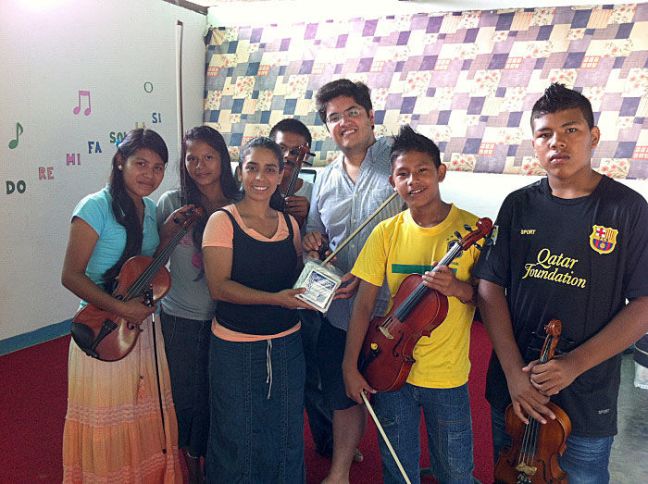
Her efforts came to the attention of Enrique Márquez, founder of MESDA Group (Music Education for Social Development Agency), which was established as part of a fellowship with Harvard University. He got in contact with Acevedo and partnered with her for three years.

“The question they had was, ‘How is it possible that indigenous children with no contact with Western European music, that they are playing that music so well?’” Acevedo said.

5ae7ac7dab160.image

Raquel Acevedo (third from left) stands with Enrique Marquez (fifth from left) founder of an organization established as part of a fellowship with Harvard University. Márquez put together a team of musicians to help Acevedo starting in 2011 as she managed a 900-plus-member music program for indigenous people, as well as to study the program’s success.

Photo by MESDA Group

Samuel Marchan, a 20-year music educator in New York City, was part of the team of musicians who annually travelled to Canaima for a few weeks to assist with instruction. He said Acevedo’s efforts were astonishing and much needed, though he worried at times she neglected herself as she prioritized the music program.

“There is no opportunity for those kids there,” Marchan said. “She was giving them another way of life.”

HEART OF DARKNESS

But to pursue her passion, Acevedo had to sacrifice her freedom.

In 2000, Acevedo’s father was called to Curacao in the Caribbean. Her options were to stay in the village with the music program she loved, or move by herself to Canada.

She still vividly recalls the day her path was decided.

“It was the worst day of my life,” she said.

Coming from church, Acevedo arrived to her home with candle light flickering. She walked into a room of people, including her parents and village leaders, who all turned to look at her.

“Then my father said, ‘OK Raquel, we are talking about your future here.’”

Acevedo listened to the plan. Per village law, she could not live by herself as a single woman, so the chief’s son — a relative of her current husband, Escriban — had agreed to marry her.

“I’m not marrying you,” she said she shouted at the chief’s son. “I was very loud and upset, and I was crying, and I left the house.”

She remembers sobbing all night as she walked through the grass of the savannah, gazing at the river and forests she loved. She hadn’t even had a boyfriend before.

“I was not ready to get married,” Acevedo said. “Even at almost 18, I was not ready to start a life as a wife.”

But more significantly, she could not abandon the members of her choir, who begged her to stay.

“I said OK, whatever you want,” she said.

Acevedo’s father declined to comment on the events, but Acevedo said her parents have since apologized to her.

After becoming a wife, Acevedo said the “machista,” hyper-masculine culture of the village was uncomfortable for her.

“Women have to be completely submitted, or they hit them,” she said, smacking her palm. “And I was not the kind of woman who submitted.”

She said not just her husband, but other men and women in the village abused her for “talking like a man.”

She was also threatened for speaking out against physical and sexual child abuse. Acevedo said after she confronted a family who she believed had multiple members molesting one of her 9-year-old students, a group of men from the family surrounded her house to threaten her with machetes.

“I saw many things that I don’t like,” she said of her years in the village.

Acevedo found refuge in the choir.

“The love I could not find in my parents, the love I could not find in my husband, I found that love in them,” she said. “I was following my dreams, and I was not going to give up just because I am a woman and I am not indigenous.”

And eventually, as she established her foundation that not only educated but also fed and clothed roughly 500 indigenous families, Acevedo said she began earning respect. She said once in a 2012 ceremony, she was even proclaimed “an adopted daughter of the jungle.”

“That’s why I rejected so many opportunities, because I had a commitment with that village,” she said. “I told them, I married here to stay here, and I’m dying here.”

However, Acevedo said the relationship crumbled once she officially divorced her first husband after 12 years of marriage, and by 2015, the Venezuelan government affirmed a mandate from indigenous leaders that non-indigenous people — including spouses — could not live on tribal lands.

Then, after Acevedo spoke out against illegal gold mining operations in the region, she received a letter from her former home asking her to no longer visit.

NO WAY BACK

Acevedo and her family are part of the estimated 1.5 million people who have fled from Venezuela in the last few years, as economic turmoil has now turned into a humanitarian crisis.

After leaving the national park, Acevedo recalled being forced to eat only cans of beets for dinner as food shortages became more common.

While Escriban’s indigenous family are doing better than most because they are in the jungle, much state assistance has been reduced. Electricity and food are in short supply everywhere.

“What money you have, you cannot pay for anything,” he said, referring to the near-worthlessness of the country’s currency, bolivars. Exchange rate estimates fluctuate daily, and the International Monetary Fund predicts inflation will spiral to 13,000 percent by the end of this year.

The country’s calamitous state has been in the works since the death of former leader Hugo Chavez in 2013. His successor, Nicolas Maduro, has been accused of rigging elections and filling crucial federal departments with unqualified loyalists.

Maduro’s authority has been further challenged by the massive dip in the country’s oil production. The industry accounts for 95 percent of export earnings, according to the Organization of the Petroleum Exporting Countries, which reported in January that Venezuela’s oil production hit a 30-year low.

However, civil unrest and murder rates have climbed. And as brazen as she is, there are many things even Acevedo will not discuss publicly for fear of endangering those still in Venezuela — or, as she calls them, people she has not yet been able to save.

“I will never take my children back to Venezuela,” she said. “Over my dead body. I have no future there, not me and not my children.”

OFF TO SCHOOL

After all seemed lost for Acevedo, she got help from a Harvard connection — Marchan, who had been encouraging her to study in the U.S. for years.

“I told her, if you want a better job, you have to get an education,” Marchan said.

Through a Houghton College professor, he secured a Skype interview for Acevedo with Dr. Armenio Suzano Jr., dean of the Greatbatch School of Music and a native of Brazil. He was blown away, and immediately set up a chance for her to audition in front of a committee, which Acevedo also aced.

“We were all amazed by the heart she brought,” he said. “She is a true musician.”

With a scholarship from the university and help from a sponsor back home, Acevedo was able to secure an academic visa.

Meanwhile, she had decided to propose to her former student, Escriban, who had supported her and her children throughout her life.

“I told him, ‘I want you to come with us. You are our hero,’” she said.

So Acevedo arrived in time for the 2017 spring semester at Houghton, with her family in tow. She studied there for two semesters, making the Dean’s List both times.

Suzano said she was not only talented, but very thoughtful and helpful to other students.

“Raquel brought a sense of deep-seated gratitude to the opportunity she was given, and she demonstrated that. She lived in a state of grace,” he said.

Funding ran out for Acevedo to attend Houghton, as her sponsor began to suffer the effects of the faltering Venezuelan economy.

However, she joined Escriban at JCC’s Olean campus, where he is studying to be a plumber. Escriban also switched her major to nursing, as she had often practiced makeshift medicine in the jungle. When asked why, she said to her, medicine is not that different than teaching music.

“You are still helping people,” she said with a smile.

Her children, Shalomi and Josué, attend Fillmore Central School and take private music lessons at Houghton.

PRAYING TO STAY SAFE

Even though Acevedo feels like she’s found home, it’s a balancing act to stay. The restrictions on her and Escriban’s visas hinder their ability to work outside of the college, and even that work is restricted.

Meanwhile, the family estimates they need to raise about $20,000 this year to stay in the U.S., which includes paying for living expenses and filing government documents. And because they refuse to work illegally, they have had to turn to the community for support.

That’s why Larry Russell, pastor of the Caneadea United Methodist Church, is one of dozens of community members helping Acevedo, Escriban and Peralta as much as possible.

He met the family when they volunteered to perform music for his congregation, and he still recalls hearing Escriban sing “I Heard the Bells on Christmas Day” for the first time.

“When he sang it,” Russell said, pausing as he fought back tears, “you just knew that God was in that room.”

The family is now well-known throughout the area’s religious community, having played at more than a dozen local venues. Russell noted it’s rare to have such well-trained musicians in the area willing to donate so much of their time. Peralta alone served as a professor with El Sistema — where he met Acevedo — and as a violist with the Simón Bolívar Symphony Orchestra under internationally-celebrated conductor Gustavo Dudamel.

That’s part of the reason why Russell’s church and others recently worked together to host two concerts at the Palmer Opera House in Cuba, both beginning at 6:30 p.m. Friday and Saturday, that feature the Venezuelan family. The performances are free and at-will donations will be accepted.

After spending a lifetime giving, Acevedo is overwhelmed to be the one receiving.

“We are blessed to be a part of this amazing place, I tell you,” said Acevedo softly, sitting in her Houghton apartment with her children beside her and Russell nearby. While Allegany County may have one of the lowest per capita income levels in the state, Acevedo and her family have found nothing but generosity — donations include their housing, the cars in the driveway, the armchair she sits in.

“And we will never stop saying thank you,” Acevedo said.

“And neither will we,” added Russell, as the two chuckled together.

(Contact City Editor Danielle Gamble at dgamble@oleantimesherald.com. Follow her on Twitter, @OTHGamble)