Past Due: Long targeted for eviction, public housing renters brace for end of coronavirus protections

(Read the series via the live link here at toledoblade.com) Part 1 of a 3-part series. Published Dec. 6, 2020. Winner in Ohio’s Best Journalism Contest for investigative reporting. Graphics by Danielle Gamble.

By SARAH ELMS, BROOKS SUTHERLAND, and DANIELLE GAMBLE, The Blade

The sheriff’s deputies showed up while she was loading her belongings into a U-Haul.

Kytrell Brown, 40, had tried in court to fight her eviction from public housing, but she couldn’t gather all the documents she needed in time to prove the lights and gas were back in her name.

The judge sided with Lucas Metropolitan Housing, after the public housing authority said she failed to maintain the utilities, owed $46.50 in maintenance costs, and failed to fill out paperwork recertifying her for public housing.

Ms. Brown waited until the last minute to move out of the two-bedroom John Holland Estates townhome she shared with her 6-year-old son, Adryin, because she didn’t have a new place to move to. She didn’t want to have to start all over once she found an apartment, so she spent the last of her cash on the truck and a storage unit.

As the calendar approaches Jan. 1, when a national eviction moratorium meant to protect renters during the coronavirus pandemic expires, many low-income Toledoans worry they’ll end up like Ms. Brown: kicked out of public housing with no place else to go.

“I was embarrassed. I was hurt. I was scared because I didn’t have really nowhere to go. I was angry. I was afraid for my baby’s life. I was afraid for my life,” Ms. Brown said. “Like, how can you put me out right in the middle of this? We could have settled this. We didn’t have to go this far.”

A BROKEN SYSTEM

A Blade investigation found LMH filed more than 2,200 evictions against its tenants in the past five years, making it one of Lucas County’s most litigious landlords. The coronavirus made 2020 an outlier, as evictions for nonpayment of rent were paused March 27.

LMH officials said evictions are a necessary tool for removing tenants who commit crimes or disturb their neighbors. But an analysis of housing court data revealed 91 percent of their cases were for past-due rent.

What’s more, 37 percent of the nonpayment cases were filed for less than $100 owed.

Filing an eviction in Toledo Municipal Court, according to its website, costs between $107.50 and $120.50, depending on whether a landlord wants to collect back rent and damages or simply wants the tenant out. That does not include how much a landlord pays a lawyer to represent them.

And for all that paperwork, The Blade found LMH stood to collect less than $50,000 in past-due rent and fees from those small-sum cases. That’s less than 9 percent of the nearly $560,000 in total past-due amounts LMH aimed to collect through evictions in those five years.

LMH manages 2,633 public housing units, most of them in Toledo and largely rented to households led by low-income black women with children, demographic data show. Tenants pay rent based on their income, and the U.S. Department of Housing and Urban Development subsidizes the rest.

Public housing is designed as a safety net to prevent people from slipping into homelessness, or to lift them out of it. Toledo Mayor Wade Kapszukiewicz, a Democrat, said Lucas County’s system isn’t working properly if families are being evicted over such small amounts of money.

“Just as a general practice, we shouldn’t be evicting people for dollar amounts smaller than the cost of filing the court papers,” he said. “Not only does it not look right, it doesn’t feel right. It just isn’t right.”

But he expressed confidence in LMH’s President and CEO Joaquin Cintron Vega, who took the helm in March, calling him a talented leader who recognizes there is a problem.

“If this is how the system works, the system is broken,” Mr. Kapszukiewicz said. “I trust that they’ll fix it.”

LMH officials defended their eviction practices in a series of Blade interviews, contending they give tenants ample notice and multiple chances to work out issues before they’re taken before a judge. LMH only uses the court process as a last resort, Mr. Vega said.

“For me, one eviction is concerning,” said Mr. Vega, who returned to Lucas County after overseeing public housing in Miami-Dade County, Fla., at the country’s seventh-largest housing authority. “When somebody loses the opportunity to remain in a place that they can call home, one is too many.”

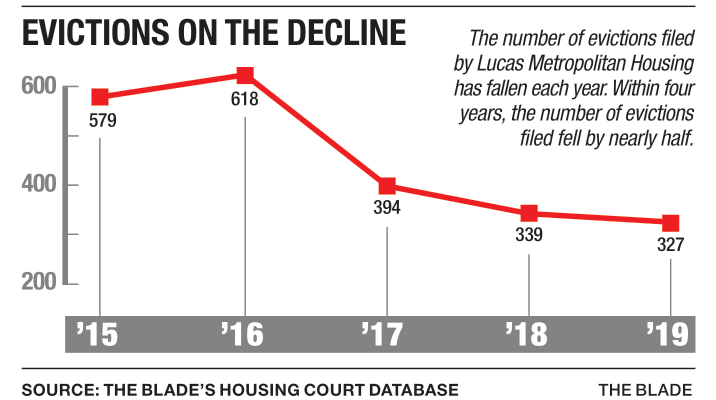
Yet records show the agency filed eviction cases against tenants more than 300 times last year – and that’s down from 2016, when they topped 600.
Housing Court data also show LMH won eviction orders in 68 percent of the cases it filed in the past five years. It’s not clear how many tenants in those cases were forced out, as LMH does not track the outcomes of their eviction cases. The dismissals include cases in which tenants moved out before their hearing date or reached last-minute settlements at the courthouse.

LMH Board President Bill Brennan said the housing authority, which gets most of its funding from the federal government, has an obligation to taxpayers to be fiscally responsible. His understanding is LMH officials do work with tenants before they take a case to court.

The Blade’s investigation has prompted him to ask if LMH can do more.

“I’m willing to put it on the agenda for the board to start discussing going forward,” he said. “It’s something I think we do need to take a look at.”

‘THIS IS LOW-INCOME’

The Blade reviewed thousands of court documents and interviewed more than 30 current or former LMH residents to understand how evictions in Lucas County’s public housing played out before and during the coronavirus pandemic.

Each person who spoke to The Blade knows well what it means when a deep-red envelope is posted on their door. They all know someone like Ms. Brown, have been under threat of eviction themselves, or have watched as bailiffs showed up to supervise the methodical transfer of a neighbor’s belongings from apartment to curb.

Eighteen of the people interviewed for this story had received the “red letter of doom,” as one LMH tenant calls it. Seven had received multiple notices on their doors in the last five years; Ms. Brown had received six. Each of them said that, in most cases, they don’t believe court action was necessary to resolve the issue.

Charlene Hughes, 37, is a single mom. Some months her expenses and income don’t quite line up, and she’ll miss a rent payment.

“They just keep on at it, and then they hurry up and try to take you to court and then hurry up and try to evict you,” she said. “This is low-income [housing]. Why would you try to evict anybody from low-income? That’s the reason why they got low-income, because they struggling.”

Last year LMH sued Ms. Hughes because she owed $50 in rent, $5 for a maintenance cost, and a $15 late-fee. She signed a “promise to pay” and got on a repayment plan for the $70, plus the court costs LMH incurred to sue her.

Ms. Hughes caught up, but it’s stressful for her to think about what would have happened to her and her 3-year-old son if she hadn’t.

“Then they’ll have you on the street,” she said. “They don’t care if you have kids.”

Five of the families who spoke to The Blade said they would have nowhere to go if evicted today. Nine said they would go stay with relatives or friends, but it wouldn’t be a permanent solution.

Before Kayla Nuzum moved into her two-bedroom LMH apartment in December 2015, she stayed at the Family House shelter in the central city. Her rent is $50 a month, the LMH minimum, and she’s usually able to pay it with the handful of hours she works at a dry cleaning shop downtown each week.

Ms. Nuzum, 32, said she tries hard to be a good tenant. Court records show LMH sued her three times between 2018 and 2019 for rent and late fees, once for $85 and twice for $50, but she paid up each time and was never set out.

She has three children and a baby on the way, and she doesn’t want to lose the home she has built for her family.

“If you put us out, where are we going to go?” Ms. Nuzum said.

When the pandemic took hold in the United States in March, the economy stalled, and unemployment levels skyrocketed. An eviction crisis housing advocates have warned about for years suddenly became top of mind.

Some relief has come in the form of stimulus checks, a government-mandated halt to most eviction cases in federally subsidized properties, and temporary changes in local housing agencies’ own policies. LMH, for example, extended an eviction moratorium through December, and the Centers for Disease Control and Prevention expanded its own moratorium on certain evictions to year’s end.

Sarah Jenkins, director of public policy and community engagement for Toledo’s Fair Housing Center, said housing insecurity, particularly for low-income renters, was already at a crisis level nationally and locally before the coronavirus exacerbated the problem.

She doesn’t see that changing when the moratoriums lift, nor once the pandemic recedes.

A quarter of Toledo’s 275,000 residents live below the poverty line, according to U.S. Census estimates, and hundreds were living in emergency shelters or on the street before the pandemic hit. The need for affordable housing in Lucas County is so great that LMH’s own 2,500-person public housing waitlist stopped accepting new names in February because the authority’s inventory couldn’t meet demand.

But even then, policies were slow to change and rental assistance was hard to come by. It wasn’t until the pandemic-induced economic plunge that governments paused evictions and prioritized financial help for renters.

“These housing needs are going to continue well beyond COVID,” Ms. Jenkins said. “Hopefully this is an opportunity now that we have the eyes of the world on this issue to really get some movement on this.”

UNDER PRESSURE

Mr. Vega and other LMH officials described their job in public housing as a balancing act.

Because of a shortage of affordable housing in Toledo, there are hundreds of families on LMH’s public housing waiting list. If a current tenant isn’t meeting their lease agreement, there’s someone on the list who will, Mr. Vega said.

Public housing authorities also have to remain in good standing with HUD, the agency that provides the bulk of their funding. In 2020, HUD subsidies comprised about $40.2 million of LMH’s $57.3 million budget, or about 70 percent.

About $25 million went toward housing choice vouchers, commonly referred to as Section 8; LMH also received $2.8 million to administer the program. The other $12.4 million closed the gap between what public housing residents paid in rent, about $5.3 million in 2020, and what it costs to keep the apartments operating.

The federal government currently considers LMH a “standard performer,” but Mr. Vega’s goal is to reach a “high performer” designation because it gives the agency more financial flexibility and a leg up when it comes to competitive funding. In order to do that, LMH must maintain a high rate of occupancy and a high rate of rent collection, he said.

What’s more, the less rent LMH is collecting each month, the less money it has to cover operations and programming costs. And that’s important because the HUD subsidies are only enough for public housing authorities to keep the doors open, experts said. There isn’t enough, for example, to fund the increasing maintenance costs of aging housing or to pay for programs residents need.

HUD’s regional and national offices did not grant The Blade an interview, but a spokesman from the Chicago regional office, which oversees Ohio, in an email said housing authorities are required to collect rent based on family income.

“Not collecting rents owed reduces the funds available for operations of the agency,” spokesman Gina Rodriguez wrote.

Housing authorities are not required to report data about evictions to HUD.

“Housing authorities have an extremely difficult job to do,” said Marcus Roth, spokesman for the Coalition on Homelessness and Housing in Ohio. “They’re charged with housing people dealing with extreme poverty, and housing authorities have been woefully underfunded for some time now. They still have to figure out how to make the finances work.”

Mr. Roth said he understands public housing authorities are in a tough financial position, but officials should work to enforce rent collection policies without taking renters to court.

“That puts them, really, at extremely high risk of homelessness,” he said. “They should generally do everything in their power before evicting people for nonpayment. It’s a terrible consequence.”

While LMH leadership emphasized that filing an eviction doesn’t automatically mean they’re putting a family out, tenant advocates argue that having an eviction case on your record equates to a red flag for landlords.

Plus, renters are more likely to settle for substandard housing — even unsafe situations that violate legal requirements — if a landlord is willing to overlook their eviction record, Ms. Jenkins said.

Ms. Brown’s eviction from LMH was a setback that came just as she was finding stability again.

She was denied two apartments because of her eviction record, she said, even though she had gotten a job with a steady paycheck.

Finally, after three months of couch surfing with her son, she found a place through a family connection. It’s in a decent neighborhood with a playground nearby, but Adryin misses his friends and his old school.

In her living room is a desk and chair, four throw pillows, two folding chairs, and an empty fish tank. Everything else is still in storage. Ms. Brown likes to cook, but her new kitchen is tiny. The place also only has one bedroom, so she and Adryin share a bed.

Ms. Brown has osteogenesis imperfecta, a brittle bone disease. A fall that might leave a bruise on most could leave her with broken bones. Before her eviction, she suffered a fractured foot, a cracked scapula, and a torn rotator cuff, which left her in the hospital for months and out of work.

She said she tried to figure out a way to informally resolve the utilities issue with her LMH property managers once she recovered, but they took her to court instead.

As Ms. Brown juggles work and parenting, she tries hard to make rent and still have money to put away. She’s keeping her eye out for a bigger place she could rent-to-own, and she’s looking into down-payment assistance programs.

If she can buy her own home, she’ll never have to deal with another eviction again.

“I don’t wish that on my enemy,” she said.

AN IMPERFECT SOLUTION

LMH leadership said the public housing authority has been trying to reduce its eviction filings, and it seems to be working.

Court records show LMH filed 579 evictions in 2015 and 618 in 2016, and those numbers dropped to 394, 339, and 327 for 2017, 2018, and 2019, respectively.

Tom Mackin, chief legal officer for the housing authority, said those reductions are a result of better communication with residents as well as stronger partnerships with advocacy groups that connect tenants to financial coaching, job training, and mental-health resources.

He also said there is a seven-day grace period before rent is considered delinquent and a $15 late fee is charged. Tenants may be delinquent three times in a 12-month period before LMH will issue a notice to vacate.

Each notice includes an invitation to try and reach a resolution with property managers during an informal meeting. It’s only if a tenant doesn’t show up to the conference or vacate their unit and turn in their keys that LMH proceeds to court.

LMH officials maintain that the informal conferences are effective, but they do not keep complete data on how many tenants take advantage of them. They also cannot say how many of those meetings led to a resolution that stopped an eviction filing.

Residents told The Blade they either didn’t know about the conference because they stopped reading the notice once they saw how much they owed, or they chose not to go because they were skeptical it would help. Those who did attend the informal conferences reported mixed results.

One tenant, a mother of three who received a three-day notice just before Christmas in 2019, said the meeting was pointless. Alexus Boyd, 21, had been in an altercation with another resident. The police responded to the incident, but no charges were filed.

Still, Ms. Boyd, whose only criminal record in Toledo Municipal Court is a traffic ticket, got a three-day notice to vacate her Port Lawrence Homes apartment. She tried to smooth things over at her informal conference.

“When I went in to talk about it, she really didn’t want to hear it,” Ms. Boyd said of her property manager. “They were saying I still had to leave and it didn’t matter because the police were called.”

She enlisted the help of Legal Aid of Western Ohio, and her case was dismissed in court.

When a 14-day notice arrived on Taberah Israel’s door, she was confused and scared. The 32-year-old pregnant mother of four had just recently moved into LMH’s Birmingham Terrace from the Family House Shelter, and she didn’t want to go back.

“I’ve never been evicted ever. It was scary,” she said.

She went to the meeting with her property manager and learned the notice was over a misunderstanding about her security deposit. She thought a subsidy covered it, she said, but LMH told her she needed to pay. They worked out an agreement, and Ms. Israel was able to keep her eviction record clean.

Ms. Brown said the first time she received a notice to vacate, the informal conference worked. She had failed to fill out her recertification form properly, but she met with the property manager and worked it out without an eviction filing.

She was able to resolve the next five evictions over late rent payments, too, but only after going to court. This summer, the process wasn’t as effective. She said she tried to work with management, but she was set out in June.

Court records show an attorney from Legal Aid of Western Ohio argued LMH should not be allowed to conduct the eviction, since the CARES Act prohibited them from March 27 through July 24. But the judge ruled that because a judgment was reached in favor of LMH on Feb. 28, before the CARES Act was put in place, Ms. Brown’s eviction could proceed.

“I believe that you’re supposed to pay your bills, OK?” Ms. Brown said. “But if life happens and there is a dire situation, then have some compassion. Work with that person.”

ABOUT THIS THREE-PART SERIES

Lucas Metropolitan Housing is among the city’s top landlords when it comes to eviction filings. The Blade set out to determine why that is, who is most impacted by it, and what can be done about it.

We conducted this investigation in partnership with the Investigative Editing Corps, founded in 2017 by Pulitzer Prize-winning editor Rose Ciotta, which pairs experienced investigative editors with local newsrooms.


Image Description

This three-part series was produced by (pictured above, from left) Blade reporters Sarah Elms and Brooks Sutherland, photojournalist Amy E. Voigt, digital journalist Danielle Gamble, and reporter Ellie Buerk. It was edited by Deborah Nelson, a Pulitzer Prize-winning journalist and professor of investigative journalism at University of Maryland; Sean Mussenden, data editor for University of Maryland’s Howard Center for Investigative Journalism; Kim Bates, The Blade’s managing editor; and Mike Walton, The Blade’s city editor.


40 minutes, $40 got me a great taste of Ellicottville

This article was originally published Aug. 11, 2018, in the Olean Times Herald.

ELLICOTTVILLE — Anyone who’s seen the swaths of chatty eaters who annually crowd downtown for Taste of Ellicottville knows “leisurely” is the prescribed way of enjoying the village’s annual food festival.

But after a busier-than-normal Saturday morning, I found myself pulling into a parking space at the ski destination just after 3:20 p.m. I knew from previous jaunts to the event that the tented food booths lined along Washington and Monroe streets would fold rather promptly at 4 p.m.

As I walked up to a ticket tent and handed over $40 for an equal number of food tickets, three older volunteers reinforced my thoughts. “They’ll be closing up soon,” warned one, her knowing look echoed in her partners’ nodding heads.

“I know,” I said with a rueful smile. “Thank you.”

I turned to my food partner for the day and handed him half of my tickets, quickly listing off vendors I knew while asking him to “pick what looks good.” He speed-walked away, and I turned to survey a burst of attendees grabbing last-minute grub.

Time for a food marathon, I thought.

Taste of Ellicottville 8-12-18 pic 1
A sampling of $40 of food at the Taste of Ellicottville food festival. (Danielle Gamble/2018)

Even in the last hour of the weekend festival’s first day, plenty of hot, fresh choices remained at every booth. Event coordinator Barbara Pump of Ellicottville’s Chamber of Commerce was being handed sizzling samples as I caught up with her.

“Because we are a tourist destination, these restaurants take a lot of pride in what they do,” she said.

Pump was quite satisfied with the day, especially with the crowd turnout. She noted the pocket-sized village hosted 24 restaurants this year — four of whom were first-time participants — while Taste of Buffalo, representing all of Erie County, had 59 total vendors.

“That’s something we like to brag about,” she said with a smile.

Nearby, attendee Dianne Roof of Buffalo said she prefers the atmosphere of Ellicottville’s tasting to her more local festival.

“This is very relaxed,” she said, noting how many open tables and chairs lined the area, beckoning families or older folks to pause and enjoy their food.

Behind her, a male companion bobbed his head vigorously, loudly agreeing.

But I had no time for tranquility. I instead zoomed over to a tent in front of Villagio, the parent restaurant to Olean’s newly-opened Mercato, to check out the tent’s best selling item — a porchetta slider.

As catering manager Andrea Austin heaped strands of seasoned pork roast onto a Costanzo roll from Buffalo — topping it with a zingy salad of arugula, Parmigiano-Reggiano and pickled red onion — she mentioned the tent was also offering a meal on Olean’s menu. She picked up a lid to a verdant mixture of steaming quinoa for those craving a Healthy Bowl.

I then scooted past several sets of families to find my food partner, who in 20 minutes had scored several prime dishes. He had bought so many treats, though, that the employees at Watson’s Chocolates had taken pity on him and given him a spare paper box in which to carry it all.

After acknowledging that perhaps we looked like a pair of foodie lunatics — what with a DSLR camera strapped around my shoulder and him carrying a carton of food — I headed to Dina’s.

Owner Jim Carls was with his staff as I grabbed a set of baby back ribs and a freshly-caramelized creme brulee. He said this was the restaurant’s 27th year participating in Taste of Ellicottville, which is celebrating 33 years.

Taste of Ellicottville 8-12-18 pic 3
A server with Dina’s restaurant torches sugar atop an order of creme brulee at the annual Taste of Ellicottville food festival. (Danielle Gamble/2018)

“We only try to do things on the menu,” he said. “It’s silly to serve something not on the menu, if someone tries something (at this event) and they want to come back.”

Down the street and around the corner, staff members of Ellicottville Brewing Company looked ready to wrap up. They joked around as they served me a mini shepherd’s pie with veal and a shiny demi-glace, scoffing at my question about festival awards they might hope to win.

An EBC crew member said he was “not really concerned with awards,” though another noted the Southwest rice bowl he had handed me had been entered as a contender.

Local celebrity judges had already wrapped up their favorite food choices — categories are Best of Ellicottville, Best Entrée, Sweetest Sweet, Kid’s Choice and Healthiest Choice, with winners to be announced today, the festival’s second day.

I whisked my dishes over to a table covered with my food partner’s finds, realizing as the clock struck 4 p.m. that we still had six tickets left.

I shoved the tickets in his palm, ordering him to “Spend these now!” as I began taking stock of the food. In a dash, he reappeared with more to eat and a zero fund balance.

We were happy to find that for the price of a cheap dinner out for two, we could feast with both refinement and gusto.

Together, we sampled:

  • Barbecue ribs and creme brulee from Dina’s. The sticky pork was easily pulled from its bone. The sugar seal, bruleed to an expert charr, cracked into delicate shards atop a smooth custard.
  • A porchetta slider from Villagio. The rich meat was cut nicely by the peppery arugula and tangy onion, and the thick roll it was served on made it quite satisfying.
  • Pork chile verde nachos from the Seneca Allegany Resort & Casino. Exceptionally-seasoned pork piled high on sturdy chips, with sweet pops of corn rounding out a hearty nacho experience. I paused to consider if the prevalence of pork dishes in front of me was to be blamed on the festival’s vendors or my own food inclinations.
  • A mini shepherd’s pie and Southwest rice bowl from Ellicottville Brewing Company. I was surprised how flaky the pastry dough remained — a non-traditional addition to shepherd’s pie, but welcome as it helped to soak up the velvety demi-glace. The rice bowl was well-seasoned, and managed to be both filling and light.
  • A cupcake flight of loganberry, lemon blueberry and chocolate salted caramel from Cupcaked. Gorgeous buttercream with pitch-perfect flavorings — the scent of berries was as heady as a bouquet of roses. I’m an admirer of good cake, and the springy-yet-dainty texture really… well, took the cake.
  • Reuben meatballs from Finnerty’s Tap Room, one of our last-minute finds and a surprise favorite. Served atop sauerkraut, with extra caraway seeds adding a sweet, earthy roundness. A plan to mimic the recipe began forming in my head immediately.
  • A glass of strawberry mint Arnold Palmer from Public House. Light and herbaceous — a much-needed refresher amongst the food selection.
  • A steak salad with strawberries and balsamic vinaigrette from Tops Friendly Markets. The produce and dressing were fresh, but could not be eaten that afternoon as we had gorged ourselves silly on everything else. It became a nice dinner for my food partner.
  • A bag of dark chocolate sponge candy from Watson’s Chocolates. Also impossible to eat after the sugar rush served up by Cupcaked. However, the decadent treat — with its rich shell covering a brittle toffee — is a holiday staple to me, and I knew it would be all the better later.

Column: Dressing up for Thanksgiving

This article was originally published Nov. 21, 2018 in the Olean Times Herald.

The first time I realized I was a Southerner was the first Thanksgiving I lived in New York.

Before then, I hadn’t really considered myself tied to one region of the U.S., which in and of itself was odd. I grew up all through Mississippi and South Carolina, so basic geography should have been a clue to me.

stuffing.jpg
Source: Pixabay

However, we moved around a lot, so I spent so much time in Southern schools as the perpetual new girl that I didn’t realize how much of its boggy residue I had in my bones.

That is, until two years ago when I found myself at a table of people my age from around Olean for Friendsgiving — that modern tradition of young people gathering their “chosen family” of friends for a potluck days before Thursday with their family.

I was thankful for the invite, as it would be the first Thanksgiving away from my family and I was not looking forward to a holiday meal alone.

I’d only lived in the area for a few months, so I was a little nervous about picking a dish that would help me make the right first impression. But after some thinking, I knew — that bready side dish with sage, broth and egg. The king of turkey accoutrements.

I’m talking about dressing.

The problem is, apparently none of ya’ll know what dressing is.

For the perpetually snowbound Northerners, I’m referring to stuffing.

Except, no, I’m not. As I learned by the edge of my great-grandfather’s kitchen counter in Missouri, dressing is when dry bread is combined with cornbread, elevated to a sage-spiked souffle and served in a casserole pan. Stuffing is when someone takes bread cubes and shoves it in a raw turkey hole so it can be overbaked into mush.

Every good Southerner knows this difference. But the young people at Friendsgiving didn’t.

So when I signed up to bring a pan of dressing, I apparently created a tide of confusion.

Why, they asked amongst themselves, would she think salad dressing was a necessary holiday side? And instead of embarrassing me with this question, someone was assigned to bring a big enough salad to soak up the bowl of “dressing” I was going to foist on them.

The day of the meal, I dispelled the groups’ uncertainty by showing up with a non-insane side dish of what they recognized as stuffing.

When I was informed about the comedy of errors after dinner, I thought several things.

1) The disposable roasting pan filled with naked salad on the buffet line suddenly made sense. It was not, as I had thought, the last-minute results of a bad cook on a health kick.

2) I was annoyed that for several weeks, multiple people thought my favorite Thanksgiving side dish was a tub of ranch. What kind of life did they think I had led before I moved to New York?

3) What kind of life had these people led that it was perfectly logical someone would bring a side’s worth of salad toppings to a potluck with no salad to put it on? Were their family trees littered with crazy uncles who insisted on bringing croutons and bacon bits to Christmas brunch?

As much as I wanted to laugh at this odd mix up, I was more embarrassed than anything. And honestly, I felt more than a little lonely.

The recipe for cornbread and chicken dressing I had brought was the same one my grandmother and father had cooked for countless Novembers. The act of making it had given me a chance to recall my dad pouring warm chicken broth over stale bread with a bright red ladle until it looked the right kind of “soupy.” The dish so thoroughly reminded me of childhood that I swore I could make out the musk of my grandparents’ old cigarettes with the smell of hot butter, sage and celery.

So to me, the mix up felt like proclaiming your love for someone in your native language, only to realize they think you’re asking if you can sleep on their dinner table. It was the first time I really felt how far away from home I had gone.


THIS SIDE DISH
farce was brought to my mind anew a few weeks ago, as I found myself
once again explaining some crucial differences between Southern dressing and New York stuffing. This time, it was to my boyfriend’s family in Portville, as we sat down for a cozy chili dinner Halloween night. The stew smelled so good, one young trick-or-treater leaned his head in the house, took a deep sniff and then tried to invite himself in for supper.

The talk that night centered around upcoming plans for my first Thanksgiving dinner with their family. I was a little nervous about picking a dish to bring that would help me make the right impression. But after some thinking, I knew.

“Cornbread in stuffing?” said his mother, her eyebrows raising a little higher than I had anticipated.

But instead of feeling nerves at the question, I just laughed and explained my family recipe, painting the picture of my dad and I cutting celery as my mom drank coffee and my older sister slept. And after a few minutes of stories, my boyfriend’s parents assured me that whatever I decided to make would be wonderful to them.

I’m not sure exactly why I’m so much more relaxed about spending Thanksgiving above the Mason-Dixon line. Maybe it’s because Western New York isn’t so alien to me after a few years. Maybe it’s because even though my own parents are so far away this year, I’ll still be surrounded by people I love.

Regardless, I know one thing: No one better bring a salad to tonight’s dinner.

Olean’s weak anti-blight plan puts stress on rental housing

(Read the live link here at oleantimesherald.com) Published Nov. 19, 2017. Winner of New York State Associated Press Association investigative reporting, third place.

By DANIELLE GAMBLE and BOB CLARK, Olean Times Herald

blight

Chris Stanley of the Citizen’s Action Network, a local activism group, goes door to door asking tenants to fill out anonymous surveys on housing conditions. The picture was part of an award-winning investigative piece on Olean housing conditions. (Photo by Danielle Gamble/Olean Times Herald)

OLEAN — At 220 N. Seventh St., the roof is broken in patches and the outside second-floor stairs wobble under one person’s weight. Bare light fixtures hang tenuously on loose planks inside the upstairs unit, close to where children are down for a nap. Downstairs, sunshine barely filters through unopenable windows covered in spray insulation foam.

“Complete violation,” declares Capt. Ed Jennings, head of the city’s code enforcement office, as he watches a video shot last June by the Olean Times Herald.

While silent video images play of exposed wiring in the living room, Jennings shakes his head in frustration.

“This is one of those houses that she just needs to kick everybody out and start over,” Jennings said.

City records show multiple citations since 2013 and attempts to require the owner, Linda Barlett of Olean, to make repairs. Some of them have been made.

Tenants said they need a place to live so they make some fixes themselves, but they are frustrated when the landlord makes minimal repairs. “It’s definitely not a mansion,” resident Kimberly Minton said, letting out a sigh. “It’s awful.”

Stemming blight in Olean is being undercut by the lack of inspectors, funding and local laws that would require landlords to bring units to code before they can be rented again. Such a law, the subject of a public hearing on Tuesday, is aimed at helping tenants like those who live at 220 N. Seventh and the thousands who live in the city’s 2,600 rental units.

Olean lags other cities its size in Western New York and Northwestern Pennsylvania that require regular inspections to fight blight.

Without such a law, Olean’s code enforcement depends on complaints from renters who have the sole power under state law to allow an inspector to enter their homes.

Neighbors call sometimes, usually to report outdoor problems. Complaints related to garbage, grass and snow account for about a third of the actions initiated by Jennings’s office since 2009, city records show. Only 8.7 percent of the actions are for housing issues.

“We don’t know where the problems exist,” Jennings said. “And some of these other occupants, they feel threatened by the owner if they call us, so we don’t get in these houses or they don’t call.”

The result is many renters living silently in dilapidated housing.

“Unfortunately, people who are in the lower income bracket who are forced to accept less-than-standard housing is kind of status quo,” said Stephanie Timblin, executive director of Olean’s Rural Revitalization Corporation, a nonprofit with a 30-year track record of helping owners fix up their homes.

While the city does have quality rental properties and excellent landlords, Timblin said, her office has responded to a range of complaints from poor weatherization to lack of running water.

“These buildings are not being kept up to code or up to the standards that seem very simple,” she said.

Olean’s housing problems have been discussed in city hall for at least a decade, but legislation has been repeatedly watered down or rejected. In 2010, a compromise led to a landlord registration law.

But talk about a law requiring inspections stalled.

That may change this year.

Alderman Kevin Dougherty, a homeowner and landlord, sponsored a property inspection law in May.

“I see other houses getting blighted out,” he said. “I watch other property next to me fall by the wayside.”

Dougherty said his proposal, which could come up for a vote as soon as Nov. 28, will motivate people to fix up their properties.

“I think the law is a good law,” said Olean Mayor Bill Aiello. “We’ve been talking about blight for years and years in Olean, and this will give us a start to bring our neighborhoods back.”

If the law passes, hurdles like funding and enforcement remain.

Even if tenants started reporting violations, Jennings said he doesn’t know if he has enough resources to respond. In 2015, Olean’s code enforcement office received 2,315 complaints, followed by 1,322 in 2016.

“You usually get a complaint on one thing and you get there and you find five other complaints or issues in the neighborhood,” he said.

As the city’s code enforcementsupervisor, Jennings has power over how much discretion to use when issuing tickets to landlords and how much time to give them to make repairs or evict the tenants. He said an order to remedy could have a timeline between 48 hours for something like garbage to a month for problems with the structure. Sometimes he warns a landlord about a violation instead of officially citing their property.

“If it’s a serious violation, we’re going to address it. But if it’s something that can get done over time and through negotiations with the owner or the occupant, we’d rather go that route than fine people. We’re not here to do that — we’re just here to get compliance and get Olean as a better place.”

Code enforcement, which is under the city’s fire department, has two staffers after a full-time position was cut. This year Jennings worked solo when his partner was on leave for five months. If the proposed law is adopted, the fees generated will allow the hiring of two part-time inspectors, Aiello said.

Lawmakers, tenants, neighbors and advocates say that unless solutions are enacted, properties that don’t meet state building codes will stay on the city’s rental market.

RENTAL DEMAND GROWS; BLIGHT SPREADS

Chris Labarge has lived at 220 N. Seventh St. for seven years, and Minton has lived there for four years. This summer, the space was shared by three adults, two children, three dogs and a group of cats.

“There’s only one door in and out,” Labarge said in a June interview, nodding up to the top of a worn wooden staircase. He was trying to repair the structure by nailing in new pieces of wood.

Shortly after, while standing at the top of the stairs, Minton said, “It’s going to go one of these days.”

City records show the property was inspected March 7, and Jennings issued a citation April 7 that ordered the stairs to be replaced within a week.

While watching video July 11 of the staircase’s condition in June, Jennings described the danger of it as “pretty severe.”

He subsequently revisited the property and found the stairs to meet “minimum standards.”

During a visit to the property Monday by the Times Herald, the stairs did not wobble under a person’s weight.

Barlett, who resides in Olean, declined multiple requests to be interviewed by the Times Herald.

North Seventh Street is a microcosm of the city’s housing woes.

Of the 12 properties on the 200 block of N. Seventh, half are rentals and three of those are owned by Barlett. Those three properties have been the subject of 17 code enforcement complaints between 2012 and Sept. 30, 2017.

On the five blocks of North Seventh there are 70 residences. Just seven of the properties generated 51 complaints in the last five years — three rentals, two city-owned, one owner-occupied and one vacant.

Residential blight stems from a decrease in homeownership and a drop in city population. Olean has lost 9,090 residents since the 1950s. Job losses followed, hurting the city’s economy and increasing the poverty rate to 23.7 percent, almost twice the nation’s 12.7 percent, according to U.S. Census Bureau statistics.

Olean simply lacks the population to fill its aging homes, and those who do remain may struggle to afford purchasing and fixing up a home.

“You see more and more people leaving the city, more and more houses sitting empty, more and more people renting,” said Common Council President Paul Gonzalez, D-Ward 3.

Blocks in Gonzalez’s ward have rental rates of more than 50 percent, such as several blocks near Franchot Park in South Olean.

Some of Olean’s housing problems stem from the age of the homes. Most are over 100 years old and not covered by the state’s most recent codes.

To assess the city’s rental properties, members of the Citizen’s Action Network activism group walked Olean’s most rundown neighborhoods last summer to distribute 400 surveys that tenants could fill in anonymously.

Only about a dozen people responded, said Chris Stanley, project leader.

“People are hesitant to complain because of fear that landlords will evict them, even though state law prohibits that,” Stanley said. He added many inadvertently open themselves to these circumstance by violating their lease agreement or paying rent late.

“There are people in our community who have needs and they don’t feel like they can speak up for themselves,” he said.

‘ALL OUT WAR’ AGAINST LANDLORDS

Dawn Shelley, of 1211 Washington St., said she is not afraid to speak out about the house she is renting from Richard Middaugh, of Alma, from whom she has rented multiple times before. Middaugh owns the most rental property in Olean, according to the city’s landlord registry.

The outside roofing is a patchwork of fractured tiles, and the basement floor is covered in puddles.

Middaugh did not respond to multiple requests for comment from the Times Herald.

Jennings, upon seeing photos of Shelley’s home, said the visible roof damage and some of the plumbing issues in her basement could result in citations for housing code violations.

Shelley thought so, too. So when she looked down the street and saw a code enforcement van earlier this year, she walked up to it and asked the officer to take a look at her property.

But when the officialgot to her door, Shelley said her wife stopped him.

“She didn’t want no problems with Middaugh,” Shelley said.

Code enforcement officers cannot enter a property without an invitation or a warrant unless there is an emergency like a fire. This invitation must come from the tenant, not the landlord, according to state law. Landlords cannot even enter their own property without tenant permission, with exceptions for emergencies or showing a house to prospective renters or buyers.

Of 2,658 rental units registered in Olean as of September, two-thirds listed owners with Olean addresses.

Middaugh reported owning nearly five percent of all rentals, the highest number of any landlord at 60 properties with 127 units. Barlett reported 26 properties with 42 units, the registry shows. Because landlords can face stiff fines for not reporting, officials say the registry lists nearly all rentals.

Both Middaugh and Barlett have a track record of responding in a timely manner to the multiple housing violations they have received on their properties, according to Jennings and City Attorney Nick DiCerbo.

“A lot of them, when pushed, will make the repairs or at least repair it enough that it meets code,” DiCerbo said. “It might not meet what we think should be appropriate. But most of the time, those landlords do comply with the orders. It’s just we have to hold their feet to the fire. And unless we get into a house we have no idea what’s going on on the inside.”

Andy O’Dell, who owns one Olean property but said he owns 80 throughout the Southern Tier, complained to the Times Herald that unruly tenants often damage properties and leave without paying utility bills. He called the city’s proposed rental inspection law an “all-out war” against landlords.

“We have no rights,” O’Dell said during a housing panel in October. “We can’t discriminate, we can’t evict, we can’t do nothing — they have all the rights.”

Jennings agreed that tenants are responsible for many of the problems he sees. He said some cannot afford to pay for garbage pick-up, while others are destructive and sometimes just “lazy.”

“Just because they are poor doesn’t mean they can’t be clean and take care of their property,” he said. “And that’s what we ask, and a lot of it is more of an educational thing for these tenants.”

But others place more of the blame on lack of oversight by both landlords and the city.

Robert Bliss, of 608 Irving St., has rented his property from Cornerstone Homes Inc. for about six years. He wants the city to enforce housing codes. He shouldn’t have to file a complaint to get an inspector, he said.

While he has a broken ceiling in his kitchen, he’s mostly concerned with problems outside — in his backyard sits a pile of siding he said has been there since he moved in.

“I’ve called (Cornerstone Homes) and they just blow me off,” said Bliss, 61.

Jennings, while reviewing a photo of the Bliss home, said he would ticket the person responsible for storing the materials in the yard.

After the Times Herald described the conditions of 608 Irving St., Angela Blodgett, Cornerstone Homes office manager, declined to answer questions on the record. She later issued a statement on behalf of the Corning-based company.

“We are all for rental inspections on a yearly basis to protect our tenants, but the tenants need to make us aware of repairs in a timely manner,” she said.

LOOKING FOR SOLUTIONS

Of 10 cities in Western New York and Northwestern Pennsylvania with populations within about 5,000 of Olean’s population, eight require residential rental inspections in some form. Officials in Batavia, Bradford, Pa., Canandaigua, Corning, Geneva, Hornell, Lackawanna and Tonawanda have passed laws over two decades.

“The concept of inspections has been discussed for years,” Gonzalez said, but during his five years on the Common Council, consensus has been hard to attain on inspections. “Right now, we have a council that fully supports this idea … Not everyone on the council agrees with every little detail of it — everyone on the council agrees that something needs to be done.”

The council is considering a proposal to inspect all city properties and issue a certificate of occupancy upon sale. The law would require inspections of all rental units upon vacancy before each unit is rented out again. It would take effect June 1, the beginning of the city’s next fiscal year.

Landlords who rent properties without a certificate of occupancy would be subject to fines from $250 to $1,000, or imprisonment up to 15 days for each day the property is rented.

Each inspection would cost $60 each, but landlords with high turnover would would pay $30 for follow-up inspections triggered by a vacancy within 12 months.

DiCerbo said he does not foresee any legal challenges that could be brought against the legislation, and credited the council for not writing in any exemptions which might have weakened its enforceability.

He added while it might take a while to “dig out of” the city’s blight issues, the new law will bring change.

“So much of the time, (council members) get beat up for not doing what their constituents want them to do or not listening to what people have to say,” DiCerbo said. “I think they did a good job this time, they thought it out and tried to balance the landlord’s rights, the tenant’s rights, the city’s rights to come up with a fair policy that applied to everybody.”

Stanley said the law as it is written would be a boon for the city as long as it isn’t “watered down” before it is passed.

Timblin said she believes the city has thoroughly researched the topic and hopes it will help low-income families.

“They have to do something,” she said of the council, “and I think the final legislation as it looks is going to be a great change in the status quo of the substandard housing that’s available.”

In the meantime,  Anthony “Tony” Ray, who also lives at 220 N. Seventh St., is worried that winter is coming and the roof needs replacing.

The city on Sept. 14 gave the owner 30 days to “remove and replace” the roof because it “has exceeded its life expectancy.” Work didn’t get started until the end of October and was shut down by the city on Nov. 15 because the workers were uninsured.

If the roof doesn’t get fixed, Jennings will issue the owner a ticket to appear in court.

“If the roof ends up leaking this winter, it will be subject to being posted unfit (for habitation),” he said.

Ray has little hope that anything will be done. “If it comes to that, I’ve got to figure something out.”

(This story was done in collaboration with Rose Ciotta of the Investigative Editing Corps.)

Drag Queen Kids Party brings wave of support to Olean library

(Read the live link here at oleantimesherald.com) Published June 21, 2018.

By DANIELLE GAMBLE, Olean Times Herald

OLEAN — Flo Leeta, covered in a sparkling white jumpsuit and a pastel wig swirled into a prominent unicorn horn, looked up from the book she had been reading — “Jacob’s New Dress.” She had just gotten to the part where Jacob was being told by his classmates that boys can’t wear dresses.

The Buffalo-based drag queen peered at the more than 70 children in front of her at the Olean Public Library with a thoughtful expression under her hot pink eyeshadow.

“There are all sorts of ways to be a boy,” she said. “Right?”

Rows of girls and boys, many dressed in princess or fairy costumes and crammed into the library’s Art Gallery, shouted back in agreement. Outside the gallery, more than a hundred parents and supporters who couldn’t fit into the space waited.

Flo Leeta entertained as part of the library’s Drag Queen Kids Party for nearly two hours Wednesday. She read two books and lip synced three times — twice to “Let It Go” from Disney’s “Frozen,” and also to RuPaul’s “Cover Girl.” She then gave a brief presentation about gender, during which she went through some history of feminine and masculine fashion and tried to explain concepts like gender fluidity.

“You know how water moves around and isn’t one shape? That’s how some people are,” she said, standing in front of a colored projection of “The Gender Spectrum.”

The event was part of the library’s efforts to highlight Pride Month for the lesbian, gay, bisexual, transgender and queer community. Flo Leeta answered questions as simple as how long it took to do her makeup — two and a half hours — and as complex as explaining what a bioqueen is — a drag queen who is a female, which is different from a man who portrays a woman as a traditional drag queen.

Afterward, a line formed as excited children, teens and adults waited to take their picture with Flo Leeta.

Nearby, Olean Public Library director Michelle La Voie was beaming, elated by the turn out.

“It was exactly like in our dreams,” she said of the community support.

For two weeks leading up to the event, library staff had received a lot of negative feedback online, on the phone and in person. They were also told there would be a protest at the event, which was supposed to include neo-Nazis — though none appeared to attend Wednesday.

La Voie said she and other library staff were initially very disappointed by the negativity surrounding their decision to host a drag queen event geared toward children, and she had been nervous things could get out of hand.

But her attitude was turned around by the dozens and dozens of supporters who showed up, and the cheers from children when Flo Leeta asked them if they wanted her to come back.

“It’s not even like my faith is restored — it’s like I have a whole other view of this community,” she said.

THOSE WHO CAME as supporters — who took up spots in front of the building as early as three hours before the event — chatted amongst themselves while wearing things like rainbow facepaint and pro-LGBTQ pins and T-shirts.

SaJean Webb, 17, came out with her family from Wellsville to support the library after seeing there would be protests.

“I have two moms and I do drag, and for me it’s like a huge thing for somebody to come into my life and say that’s wrong. Because it’s not — it’s just how we live our lives.”

Webb said she was happy to see the library host an event specifically for children with positive information about the LGBTQ community. To her, it’s a step toward helping people understand the life she and her younger sister have had.

“If you teach your kids that that’s wrong, you’re going to teach your kids to hate, and they’re going to grow up and hate, and that’s not OK.”

One of her moms, Danielle Freeman-Braven, said even as she has served on the board of the Olean-based LGBTQ group COLORS, she had never seen local people motivated to protest an LGBTQ event.

“(Flo Leeta) is just pushing for you to be happy and love who you are,” she said.

Though a Pennsylvania leader of the National Socialist Movement publicly stated the organization would be at the event, they did not appear to attend. Law enforcement and library officials also said they saw no protesters from the neo-Nazi group at the library all Wednesday.

The protests remained peaceful, which La Voie chalked up to the heavy presence of police and supporters. Roughly eight Olean police officers were present, including Olean Police Chief Jeff Rowley, as well as a New York State Police officer.

As officers patrolled, Olean Mayor Bill Aiello stood across the street from the library. He did not attend the reading, as he said he had family commitments, but added he stopped by beforehand in case citizens wanted to talk with him, as well as to “make sure this is going to be peaceful.”

At the northwest corner of the library, across the parking lot from supporters, a group of less than 10 protesters gathered with signs that included statements like “Leave our children alone!” and “Keep kids innocent.”

Protester Jonathan Smith, of Olean, asked why Flo Leeta was appearing in her performance attire and not as the male performer who brings her to life, Benjamin Berry. Smith wrote a letter to the editor to the Olean Times Herald against the library’s drag queen reading event, and said he was specifically against a publicly-funded organization hosting it.

“If you want to read a story book to children, come and do it,” he said at the protest. “But then he’s being political coming out as a drag queen and that’s already a sexual thing, so that adds a sexual flavor to the story book reading concept.”

He also said he felt Berry lacked any qualifications to host an educational event. When asked for his thoughts on Berry’s background in education — Berry, an Alfred State College graduate, has for years hosted events for children as a hula-hoop instructor and drag queen, and is a teaching artist with the nonprofit Young Audiences of Western New York — Smith said the concepts to be taught at the library event were too inappropriate for young children.

“Children don’t need to be exposed to gender expression — they’re children,” he said. “What does gender expression have to do with childhood?”

Pastor Rick Peters, an Olean preacher with the church God’s House of Refuge, said he protested the event because he believes the LGBTQ community represent a “sexual sin” that is “totally against God’s principles of life.”

“God loves them people,” he said, gesturing to the group of counter-protesters. “But that doesn’t mean their lifestyle is right. It’s wrong … I love them, I love the drag queen. That’s why I’m protesting — I don’t want to see anybody go to hell.”

On the other side of the parking lot, COLORS co-founder Alan Hadden also brought up religion.

“My thought is,” Hadden said, “God made us. If he didn’t want us this way, we wouldn’t be here.”

His husband, Dann Deckman-Hadden, the other founder of COLORS, said he was happy to be a part of the support for the event along with several local drag queens and drag kings. He estimated about 30 locals are drag performers.

Deckman-Hadden said the type of education provided Wednesday that normalizes the LGBTQ community is in line with everything his organization tries to do locally. His group is set to host a Saturday all-age drag show from 3 to 6 p.m. at the Loyal Order of Moose Lodge, 201 W. State St.

“What we do is not just for gays, lesbians, transgenders — it’s for everybody,” he said.“Also, gays and lesbians have children, too,” added Hadden.

Hadden said the highlighting of the LGBTQ community, especially during Pride Month in June, was just as important as highlighting other minority groups.

“If you had a black person in there talking about slavery, would (protesters) be here today?” he asked. “No.”

Deckman-Hadden said the concept that drag is inherently sexual comes from a prejudice that members of the LGBTQ community are more likely to have pedophilic tendencies — an idea that several institutions such as the American Psychological Association flatly reject.

“We are not sexual deviants,” said Deckman-Hadden, whose drag persona is Veronyca DeVaine-Paige. “Drag is a way of how people express themselves. It’s expressing their creativity and art.”

(Contact City Editor Danielle Gamble at dgamble@oleantimesherald.com. Follow her on Twitter, @OTHGamble)

Olean library drag queen event for kids met with some backlash, much support

Pride Month reading hour to be attended by supporters, police, neo-Nazi protesters

(Read the live link here at oleantimesherald.com) Published Nov. 19, 2017. Read the follow up here.

OLEAN — While the Olean Public Library has been celebrating Pride Month and the LGBTQ community all June, one event in particular has captured public interest and inflamed a local debate over introducing children to the concept of drag.

Flo Leeta, a Buffalo-based drag queen, will read children’s books about self-expression and answer questions about gender at 6:30 p.m. today at the library during a Drag Queen Kids Party. She will read “Jacob’s New Dress” and “Morris Micklewhite and the Tangerine Dress,” children’s literature that Olean’s Programs Director Jennifer Stickles said has been on the library’s shelves for years.

While the event was announced at the beginning of the month, Stickles said negative social media posts began trickling in last week, as well as phone calls to the library and roughly 10 visits by those who wanted to share their disapproval in person.

Also, a Pennsylvania leader of the National Socialist Movement announced plans on social media to protest the event with others.

“It’s been rough for me this week and last week, too,” Stickles admitted.

However, she and Library Director Michelle La Voie said they are committed to hosting Flo Leeta. In fact, the number of people who expressed interest on the library’s Facebook page jumped from an expected dozen or so to more than 200 as of Tuesday.

“I’m worried about the event, because I don’t want families to show up and have an upsetting time,” La Voie said. “But I think it’s also educational for people to see what’s risen to the surface, and what we have to contend with as a society.”

STICKLES SAID SHE was inspired to host this reading after seeing news articles about Drag Queen Story Hour, an organization that began in San Francisco in 2015 but has since spread to cities across the country. The concept that drag queens could be invited into educational venues to read to children was lauded in professional journals she read, and she also saw that such a January reading in Binghamton was received very positively — an official with the Broome County Public Library said over 200 people attended their event.

And because the Olean library’s other programs representing the lesbian, gay, bisexual, transgender and queer community had been embraced over the last few years — including Rainbow Alliance for LGBTQ youth support group, which launched in February 2017 — she wanted to see how locals would respond to a program for even younger kids.

“It’s just like any other storytime program in our library,” she said. “The difference being the person reading the book happens to be dressed in age-appropriate drag and reading picture books that show kids of LGBT families that they’re normal.”

Stickles noted that it was a plus that the performer who brings Flo Leeta to life, Benjamin Berry, has for years hosted multiple events for children as a hula-hoop instructor, entertainer and drag queen. He is also an Alfred State graduate and now part of the roster of Young Audiences of Western New York, a nonprofit that works to pair teaching artists with opportunities to instruct kids in creative programs.

For more information, visit www.benjaminberry.com.

Flo Leeta — who is not affiliated with Drag Queen Story Hour — said her program is going to be “equally entertaining and educational,” and she’s excited to spotlight LGBTQ people in a rural area.

She said the event will not only include reading, but also a lip sync performance to “Let It Go” from Disney’s “Frozen” and a question and answer session about what it’s like to be a drag queen as well as any LGBTQ topic. She said both kids and adults can ask questions.

“That part of the program may go over, because I think the community has a lot to unpack,” she said.

Flo Leeta said many of those speaking out against her appearance in Olean seem to misunderstand the point of it. She said the purpose is to humanize members of the LGBTQ community and make children comfortable with how they want to express themselves.

“For me, drag is all about confidence,” she said. “It’s about being as loud and bold and colorful as you want, so I want to set that example for the kids, and I also intend to send out the message that when people are being bullies — like there might be some really big bullies outside of the library — I want to show them that you need to be the bigger person and not punch back, and just be who you are and not be afraid of them. Because then they win.”

STICKLES SAID THERE have been many rumors surrounding what kinds of controversy have been stirred up as the library’s drag queen event neared. She clarified that no threats of violence have been directed at her or the library, to her knowledge.

However, a protest is planned, according to Daniel Burnside of Ulysses, Pa., a regional director for the National Socialist Movement. Burnside — who said his region of the neo-Nazi organization covers Pennsylvania, New Jersey, Maryland and Delaware — told the Olean Times Herald on Tuesday he planned to protest the event with about half a dozen others.

“I’m planning on being right there in the area to basically see what’s going on,” he said.

Burnside said he and the protesters joining him all have children, making them feel it’s their “responsibility to make an appearance.” He said the literature Flo Leeta planned to read is “poison” that was part of a “Marxist agenda to create gender neutrality.”

“I think a guy should be able to go there in a National Socialist uniform and read Julius Streicher’s ‘(The) Poisonous Mushroom,’” he said, referring to an anti-Semitic children’s book published in 1938 meant to teach children to fear Jewish people. “It’s no different than what they’re doing. So, you know, it’s completely wrong. It’s wrong, the wrong place to be doing it — not a public library.”

When it was said that some attendees were worried the protest could turn violent, Burnside responded, “Why, is antifa going to be there or something?” referring to protesters who  commit anti-fascist violence and who often engage neo-Nazi organizations. When told no, he said, “Oh, well then there probably won’t be any violence. I haven’t met a Nazi yet that perpetrates violence.”

Olean Police Chief Jeff Rowley said “one or two” officers will be at the library today to make sure everyone at the event is “well behaved.” He added he is prepared to call in more officers, including those with the Cattaraugus County Sheriff’s Office, if he deems it necessary.

Rowley said his office hasn’t previously had to deal with any issues relating to the National Socialist Movement, adding this is the first time in his memory he has faced this type of activity.

Director La Voie said when she initially spoke with Rowley, he suggested she cancel the event.

“I said I disagreed because I felt that would be giving in to forces, and showing them that when they do these kinds of things they can make people back down out of fear,” she said.

Rowley said while he did recommend cancelling the event, he did not do so in his capacity as chief of police, but as someone concerned for the welfare of the children attending the event.

“I understand both sides of it,” he said. “People don’t want to give up their freedom of expression or their speech, and if they allow the haters to cause them to cancel it, then the people have lost their freedom of speech.

“But when it comes to children, I think you need to step back and think about it a little more.”

La Voie said while she is also concerned that young people at tomorrow’s event might be exposed to neo-Nazis, she thinks it would be worse for her to cancel an educational event that “hit a nerve in this community” — especially because she fears it could encourage protesters to continue using strong-arm tactics to shut down other LGBTQ-related events.

“It’s just the wrong thing to do,” she said.

There will also be a collection of counter-protesters. Officials said the library was contacted by a community member who began organizing people to come early to the event and make attendees feel safe.

Stickles said the group includes people who are planning to bring rainbow umbrellas in order to block the view of protest signs, and those who will offer to escort attendees to the library if they feel scared. The point of the group, she said, is to “be here and be supportive and make it feel safer for those that are bringing their children.”

The organizer declined to speak to the Times Herald on Tuesday.

Rowley discouraged unofficial volunteers who might try to protect event attendees.

“We (the police) will handle the situation — we would rather not have a self-appointed group of security personnel show up. It could just complicate matters,” he said.

However, he added those who could not be discouraged from offering protection should at least identify themselves to officers once they arrive at the library.

While La Voie stressed counter-protesters were not requested by the library, nor affiliated with it, she didn’t seem to mind the support.

“I don’t want people to get into trouble or start anything,” she said. “However if we have hate groups that are going to be here, it doesn’t bother me we’re going to have good people here, too.”

BURNSIDE WAS ONE of multiple locals who spoke out against the event. Several voiced objections to Flo Leeta’s program online, with reasons ranging from religious beliefs that LGBTQ people are sinful to the idea that dressing in drag is abnormal behavior. Others said a program featuring a drag queen is inherently sexual and therefore inappropriate for young children.

“This is a shameful use of our hard-earned city tax dollars that sexualizes the otherwise beautiful act of storybook reading to children,” wrote Jonathan Smith, of Olean, in a letter to the editor sent to the Olean Times Herald. “How does the library justify using public funds for the sexualization of children?”

Stickles, who is a lesbian, said one person recently visited the library and told her she was a danger to the children because of her orientation.

“We have people calling saying, ‘I know you have a lesbian there running your programming,’” she said. “But I don’t know why my private life matters to them… I’m still going to provide the community with programs they need and want.”

Stickles and La Voie said they have been trying to focus on the overwhelming amount of positive feedback from people in the area and outside of it, which included several library officials and former local residents from as far away as Oregon.

“I think it’s great that people support the library. It’s always great to see people support the library for something that’s good and to see people step up,” Stickles said.

Meg McCune, an associate professor at Jamestown Community College with a PhD in anthropology, said she’ll be attending the the drag queen story time with her young child.

“I’m thrilled the library is having this event,” she said. “If I don’t support it, I feel the people attending the protest win.”

While she respects other parents decisions not to go — “I’d rather not bring my daughter around Nazis,” she said — she sees the event as a way to give her child access to diversity as well as something that increases the value of the community.

“Plus it’s just fun,” she added. “At the end of the day, you have a trained performer for kids.”

(Contact City Editor Danielle Gamble at dgamble@oleantimesherald.com. Follow her on Twitter, @OTHGamble)


A year after heroin: One Olean family’s tragedy, a nation’s epidemic

(To read the original story, visit oleantimesherald.com. Published June 10, 2018.)

OLEAN — As a group of family and friends gathered fistfuls of balloons to release into the sky above War Vets Park on Tuesday, Karen Materna was still scrambling a bit.

“Don’t let them go yet,” she called out. “I’ve got to finish this note.”

The note, written on yellow paper, was for her son Mathew Chaffee, on the one year anniversary of his death.

Chaffee died June 5, 2017, one among a string of Olean men who had overdosed within a days of each other. Those deaths sparked a vigil that brought 300 people to Lincoln Park, which included a makeshift memorial of photographs of those that have died from addiction, as well as a release of orange and purple balloons.

On Tuesday, a memorial of photographs were again hung, and balloons — red and black — poured into the sky.

“I love you baby,” said Chaffee’s mother, softly, as she watched her note float toward the heavens. “I love you, Matty Matts.”

Through this ritual, his family hopes to keep a piece of Chaffee alive, as well as remind Oleanders that addiction in the community still needs to be addressed.

Meghan Materna, Chaffee’s younger sister, said it’s been a rough year for the family, which includes her mom and her younger brother Michael.

“We’ve just been trying to push through it,” she said. “It’s still surreal to us. He was a great person and he had three beautiful kids, so we just want to keep his memory going … I want to do this every year for him.”

The tight-knit family seems to get through some of their struggles by supporting each other and remembering the good things — like Chaffee’s love of the rapper Eminem, and his great sense of humor. And they celebrate the legacy of his children — Amara, age 11, Alayna, age 6, and Peyton, age 6, who Materna said is the spitting image of his dad.

Meghan in particular holds on to the number 29, which signifies both the age of her brother at his death and  “guardian angel,” according to Pastor Tyrone Hall of the Lighthouse Church in Olean, who presided over her Chaffee’s funeral.

“We call him our Angel 29,” she said. She has clothing where Angel 29 is emblazoned, as it was on his park memorial.

But his family all miss the simple things. Karen Materna still wishes she could do her son’s laundry, especially if that meant seeing him burst through her door with his loud, teasing jokes.

“It’s hard. It’s hard as a parent because,” Karen paused, tears coming to her eyes, “your kids aren’t supposed to go before you.”

WHILE THE DEATH toll of last year still looms over the community, officials said opioid overdose statistics seem to be leveling off.

There were a total of 11 heroin overdoses that lead to death in Cattaraugus County in 2017, according to provisional statistics from the county Department of Health. Before then, there were 10 deaths in 2016. The state’s department also registered 11 heroin/opioid overdose deaths in 2015 in the county.

Compare that to the three opioid overdose deaths that have been counted so far in 2018, according to Dr. Kevin Watkins, director of the county health department. Watkins said on Friday he had that day received another death certificate from January that showed fentanyl was the cause of death in one more county resident.

“That’s still three deaths too many for us, because these are preventable deaths,” Watkins said.

However, he also finds promising that the use by EMS, fire and police of the overdose antidote Narcan has also dropped. Narcan usage in 2015 was 42, climbing to 68 in 2016, down to 45 in 2017 and only 13 so far this year.

Also, as the county has pushed Drug Take Back Day events, Watkins said they have been collecting “hundreds of pounds” of extra prescription drugs. He also noted more drug providers are getting trained on cutting back opioid prescriptions, and local rehabilitation services are using medication-assisted treatment therapy more often for opioid users, which he said is far more effective for recovery.

“This is all helping us,” he said.

Watkins has been immersed in the topic since the county’s heroin/opioid task force was formed two years ago as heroin overdose deaths in the area were spiking. The group is comprised of more than two dozen agencies, including law enforcement, medical personnel, nonprofits, family members of addicts and former addicts.

It’s been at that task force were he has heard positive reports from the Southern Tier Regional Drug Task Force about pulling more heroin and other drugs off the street, and from the Council on Addiction Recovery Services (CAReS) as members build a new facility with 20 treatment beds in Westons Mills in addition to their adjacent 16-bed CAReS treatment facility for men.

“We really do feel a lot more positive now,’ Watkins said of the task force. “At one point, we couldn’t even find a rehab center for someone in the community.”

However, Watkins said he cannot clearly point to which of these efforts is making the biggest difference. His reasoning is all speculative.

There could be more fear-inducing factors at play, too.

Last year the Cattaraugus County District Attorney’s Office for the first time ever charged dealers with users’ deaths, including three Olean women with criminally negligent homicide, a class E felony, for allegedly selling fentanyl-laced heroin to three users who later fatally overdosed. Only one, Chelsea Lyons, 27, was convicted. She was sentenced in June to one to three years in state prison for her role in 42-year-old Matthew Harper’s February 2016 death.

Another deterrent could be the increase of heroin-laced fentanyl — the opioid responsible for most overdoses, as it can be 50 times more potent than heroin. However, Watkins offered that anecdotally, a user on the taskforce said education on fentanyl might not actually be a deterrent, as it would make them chase after the drug harder to feel a stronger high.

“We’re not sure of why we’re seeing the leveling off of opiod deaths in the county,” he said.

THE FAMILY KNOWS where Chaffee’s addiction started — a severe car accident at age 24.

“He ended up breaking the bone that connects your head to your neck, and a lot in his jaw,” Meghan Materna said. “We almost lost him then.”

He was prescribed opiods to handle the pain, and his mother said that first dose spiraled into him wanting “more and more and more.”

“I called his doctor and I said, ‘You give my kid pills again, I’ll report you.’ Because I didn’t want to have them any more,” Karen Materna said.

Cattaraugus County has one of the highest rates of opioid prescription in Western New York.

But later, she realized without a prescription, Mathew began turning to friends and experimenting with multiple drugs — everything from heroin to cocaine to meth. His sister said there wasn’t a drug Mathew wasn’t ready to try.

“I blame myself,” his mother said. “Everybody says I shouldn’t, but everytime he wanted money, everybody would just hand it over to him and he would say it was for food or something, but it wasn’t. So I was part of his addiction.”

Then Chaffee decided to get clean. His mother said he called her one day after he stopped taking pills.

“He said, ‘Ma, I think I’m having a heart attack.’ I said, ‘You’re not having a heart attack, you’re withdrawing.’”

She drove him to the Erie County Medical Center — where staff remembered him from his car accident — and then was able to secure a spot for him at a long-term rehabilitation facility.

He spent over six months in rehab, his family said. And then he died about two months later.

Meghan said she remembered how upset Mathew was to hear the passing of his buddy, Richard J. “Ricky” Cummings, who succumbed to his own addictions May 31, 2017. She said both grew up together and went to the same rehab.

“I remembered I looked at my brother’s Facebook page and when Ricky died, he wrote, ‘Man I don’t know what to say, I’m lost for words.’ And then five days later, Mathew’s gone.”

Chaffee’s overdose happened at a friend’s house, caused by being injected with a drug mix that his family said was more than 90 percent fentanyl, according to toxicology reports they received.

With Chaffee’s death, Karen Materna became a supporter of Winning Back Olean, even asking for memorials in Mathew’s name to be donated when he died. The organization formed in June 2016 to provide support for those struggling with addiction and is working to become a nonprofit organization. Shannon Scott, executive director of Winning Olean Back, was at Chaffee’s memorial Tuesday.

The family said they hope the memory of Mathew could serve as a cautionary tale to those tempted by drugs, and a warning to those facing addiction.

“I wish I could go to schools and talk,” Meghan Materna said, “because I feel like it’s just getting worse. It hasn’t happened a lot lately here, but when it was all happening (the victims) were just getting younger and younger.”

Even a year later, Meghan Materna is not satisfied with the resources allocated for educating youth to prevent addiction. And she thinks the stigma of who heroin addicts are is still holding strong.

“This needs to be taken a little bit more seriously than the police are taking it and what the community’s taking it,” she said. “People say, ‘Oh they’re scumbag druggies, screw them.’ No. They have a problem and an addiction, and it’s hard.”

WHEN ASKED IF the county has responded effectively enough to the need for preventing drug addiction, Watkins said plans are in the works to increase students’ access to drug education. A recent Community Health Assessment taken on by the county health department and Olean General Hospital highlighted drug prevention as a priority, and decided to bolster CAReS adolescent programs in area schools by funding three drug educator positions instead of one.

“I believe that should happen in September,” he said. “Then we’ll be able to get more drug educators in the school.”

He also said the state has just begun to release more funding to address heroin and opioid addiction services.

“It takes resources to get this done in a timely manner,” he said.

In the meantime, another threat has been raised — officials at the May county heroin/opioid task force meeting said the stagnation of the heroin epidemic has led to an increase in use of meth, cocaine and crack cocaine.

As of early April, five alleged meth labs had been discovered in five city apartment buildings and a total of 11 people have been charged over the last five months. Since December, there have been three fires at three city apartments that allegedly housed meth labs. The latest fire occurred March 28, as a tenant of 119 Irving St. was charged with making meth hours after a fire caused the entire building to be demolished.

Additionally, the Cattaraugus County Sheriff’s Office charged two Olean residents March 29 at a Microtel Inn & Suites in Allegany after responding to a noise complaint and instead reportedly stumbling upon a small methamphetamine lab.

Also, in what Olean police called one of the city’s largest drug busts of the last few years, 10 people were rounded up March 8 to face drug-related charges following a search of two homes simultaneously that allegedly netted almost five ounces of cocaine valued at roughly $14,500, as well as $3,137 in cash.

Watkins said deaths directly caused by drugs are down, but he admitted these new drugs present new problems to deal with.

“Now this is a whole different dimension in seeing the rise of other drugs, so that’s not something (the heroin/opioid task force) might be asked to look at — maybe we might in the future.

“But at the same time, that’s definitely on our radar, because it’s important to stay vigilant in our community.”

(Contact City Editor Danielle Gamble at dgamble@oleantimesherald.com. Follow her on Twitter, @OTHGamble)

After year of searching and decades of separation, Olean native has loving reunion with Bradford birth mother

(To read the original story, visit oleantimesherald.com. Published on Mother’s Day, May 13, 2018.)

By DANIELLE GAMBLE, Olean Times Herald

Marian Robarge hated Mother’s Day for quite a while.

It’s not that she’s a Hallmark holiday cynic. It’s just when her kids would bring her gifts and try to celebrate the occasion, Robarge would invariably think back to the woman who raised her in Olean since the day she was born, Thelma Joseph.

Robarge describes her as a tiny woman with a big heart of Lebanese descent. Together, the pair were like Sophia and Dorothy from “The Golden Girls” — Joseph like Estelle Getty at roughly 4’10 in high heels, and the nearly 6-foot-tall Robarge as Bea Arthur.

Joseph passed away 22 years ago, and the loss left Robarge empty.

“There was always a hole in my heart because I couldn’t celebrate Mother’s Day anymore with my mother,” she said. “It reminded me of what I’d lost.”

This year, however, 53-year-old Robarge is in the holiday spirit. After traveling down from near Albany, where she’s lived with her husband for nearly a decade, she’s going to a Mother’s Day tea today in Bradford, Pa.

But first, she has to find out what tea her mother likes — herbal, it turns out. Robarge perfers Earl Grey.

“How do you like your tea?” she asked the woman who gave birth to her, Marguerite Srock, as she sits on the bed at the Pavillion retirement home.

“I like it plain,” Srock responded.

“Me, too!” exclaimed Marian, a big smile on her face.

In the smile, you can sense Robarge’s delight is less in the answer and more about the discovery. Because after more than five decades of waiting to meet her birth mother, learning about food tastes for Robarge is equal parts connecting with family and discovering pieces of herself.

IT WAS A long journey for Robarge to uncover her connection to Srock.

Robarge had known she was adopted since kindergarten, after she asked Joseph about why Robarge had no siblings.

“She explained to me that although they were my mom and dad and they loved me very much, somebody else had given birth to me and they had adopted me as soon as I was born, and that that never changed how they felt about me,” she said.

And that was how it felt for Robarge, whose parents had waited on a list for seven years before the opportunity came to adopt her. She said she had a great childhood with a family that gave her all the love she could want and a good private education at Southern Tier Catholic School and Archbishop Walsh Academy.

But while her adoption was no secret, she remembered the Josephs changing the subject about the topic even when Robarge brought it up. So she learned to not ask about her birth mother.

“I would say ‘Happy Mother’s Day’ to my mother, and in my heart, I would always say, ‘And wherever you are, whoever you are, thank you.’ Because the life that this woman gave me by giving me up, it was an incredible life.”

It wasn’t until her father died in 2003 that she discovered her first clue about her birth mother’s identity in a lock box: a pair of adoption papers with the maiden name of her mother and a father “unknown.”

For many years, the idea of finding her birth mother wasn’t a priority for Robarge. Not only was she happy with the life she had, but she didn’t want to do anything that would have made her adoptive parents feel devalued if they had still been alive.

“I kind of put it out of my mind,” she said.

However, after a close call in January of 2016 with blood clots in her legs that prompted several questions about her medical history, Robarge decided to finally look for some answers.

“At that point, I felt extremely lost, I was like, ‘What else might be lurking out there? What else don’t I know?’”

FIRST, ROBARGE SENT an email to the TLC show “Long Lost Family,” which reconnects family members who have never met or have been separated for a long time, and waited for a response. But that summer, after searching her mother’s name in newspapers.com, she got a hit on a 1952 Bradford Era article listing off kindergarten homeroom assignments.

“Once I found the kindergarten listing, I couldn’t go to bed. I was literally up until 5 o’clock in the morning sitting on the computer,” she said. “To me, in my heart, I thought this had to be it.”

Her madcap search pulled up more articles. She read about her mom’s husband who died in a 1974 construction accident in Kane, Pa., after the pair had been married only four years. She found a family obituary that listed her mother as a survivor still living in Bradford.

But her mother had no social media accounts — just a few public addresses.

“I thought, ‘I’m going to write a letter and let’s see what happens,’” Robarge said.

Through the rest of the year, eight letters were sent out. Each came back unread, unanswered after weeks of waiting.

“And every time they would come back to me, I would get more discouraged,” she said.

Robarge had reason to worry — she said the majority of adopted people she’s met have had poor experiences with meeting their birth parents, especially when the child was born from abuse. And because the kindergarten listing put her mother at age 15, Robarge was suspicious about the circumstances surrounding her birth.

So when “Long Lost Family” contacted Robarge, she declined their offer in case their findings embarrassed who she assumed was her mother.

“As much as I wanted to find this for myself, I had to put her ahead of me,” she said.

And besides, she was able to keep her faith with the support and encouragement from her husband, Mark, a journalist who was with the Troy Record.

After a year of searching for addresses and phone numbers, Robarge finally decided to contact her potential half-brother, Scott Srock, on Facebook. She had found profiles for him months back, personal and for his tattoo business in North Carolina, but didn’t want to reach out in case he had never been told about her.

“I didn’t know what he knew about me, if he knew about me, if it might change his relationship with his mother — I had no idea,” she said. “Are you going to go blow somebody’s life apart?”

After an agonizing talk with her husband, she wrote a long message to send to his professional Facebook.

She hit send.

Within an hour, she saw someone had read it.

She waited.

And then, through tears as fresh as the day the message popped on her screen, she described her brother’s response:

“Oh my God, we’ve been looking for you but we didn’t know how to find you,” she cried. “Yes yes yes, you have the right family.”

She said the feeling of not only finding her family, but having them ache for her as much as she had ached for them, created the most powerful emotional release she’d ever had in her life.

“It was like a weight lifted off of my heart,” she said. “I think as you get older, family does become very important. And knowing there was a piece of me missing somewhere, it was a huge relief to make that connection.”

Robarge said her mother had, after a breakdown a few decades before, told Robarge’s half-brother about his long-lost sister. As soon as he was able, he called her.

“We both just sat on the phone crying our eyes out and talking,” she said. “I think we talked for three hours that night.”

It turned out Robarge’s mom was alive and indeed, still living in Bradford. No addresses had been available for her because she had been placed in The Pavillion nursing home due to some physical disabilities, but she was mentally healthy.

FINDING HER MOTHER meant uncovering a truth that Robarge had feared — Srock had become pregnant in the mid-1960s as a result of being a victim of a sexual assault. And worse, Srock said the act had been perpetrated by a non-biological family member she declined to publicly identify.

Srock realized she was pregnant the day before she gave birth to her daughter. She said at 15, she came home from school feeling sick March 30, and after an examination, she was told she was going into labor and was transported to Olean to deliver March 31.

While Srock is thankful her daughter was raised by such a loving family, she can’t help but feel giving Robarge up was the choice made for her, but not by her. And Srock was firm that she has never blamed Robarge for the painful circumstances of her birth.

She said she still remembers holding her baby girl one last time.

“I had to carry her down to the first floor of St. Francis Hospital in Olean,” Srock said. “She was wrapped up in a blanket — I couldn’t see her face — and her adoptive mother and father were there. This was at the back way of St. Francis at the time. I had to hand her from my arms to the arms of her mother. That’s when the emptiness started.

“And she said thank you to me, but I couldn’t say anything because I was on the edge of ready to explode.”

Srock said six weeks later, she was back at school, keeping the abuse secret for most of her life and never again discussing the pregnancy with her own mother.

Thoughts of her daughter would come periodically to Srock, she said, sometimes in her dreams and sometimes as strong memories brought on by the very show Robarge almost went on — “Long Lost Family.” But it wasn’t until her son called her last Easter that Srock, in a daze of discovery, really believed she would meet her daughter again.

“I thought, ‘Why would she want to see me?’” she said.

“I thought the same thing about you,” laughed Robarge.

Within days of connecting with her birth family, Robarge arrived in Bradford to greet her half-brother and her birth mother on Easter weekend.

“I can still see her standing at the door, crying her eyes out,” said Srock with a smile, adding the first thing she noticed was how strong a resemblance the pair share.

Srock was thrilled to find out she was a grandmother to Robarge’s two sons, 29-year-old Jordan and 27-year-old Jared, and a step-grandmother to two 12-year-old twins. And she was a little “flipped,” though equally happy, to find out she was a great-grandmother to a three-year-old girl.

Even though meeting was exciting, Srock said it was hard to get to know each other because she didn’t know what to say to her daughter or how to say it. Robarge compared it to “when you first start dating someone.”

And sometimes, things are still “weird” for the both of them, like when they think about buying gifts. Even though Srock knows Robarge loves royal blue and they both like eggplant, so many tiny details that take a lifetime to collect are missing.

But more importantly, the instinct is there for Srock to express her love for her daughter. And after a year of weekend visits and almost daily phone calls, the two are getting more comfortable playing catch-up.

“(My search) may have started off for medical reasons, but it’s so much more than that,” Robarge said. “I’m glad that I did it.”

And sitting across from her daughter the weekend of their second Mother’s Day together, Srock is just as grateful that her dreams have become reality.

“You were just across the state line this whole time,” she chuckled, shaking her head as her daughter smiled.

(Contact City Editor Danielle Gamble at dgamble@oleantimesherald.com. Follow her on Twitter, @OTHGamble)

Her songs of hope: How Raquel Acevedo’s music, faith helped her grow in the Venezuelan jungle and journey to the US

(To read the original story, visit oleantimesherald.com. Published April 30, 2018. Winner of 2018 Excellence in Feature Writing award by New York News Publishers Association.)

When Raquel Acevedo makes music, every movement is like a prayer.

Her brow knits when she sings high into her chest voice, as she did weeks ago while playing the worship song she wrote. Her fingers took measured strokes on her guitar in her Houghton apartment.

“Tú me llamas si no tengo palabras,” she sings with her husband, Daniel Escriban, while family friend David Peralta plays viola. “Solo lágrimas derramo de ti.”

Acevedo is telling God that when she has no words, he speaks for her. And because of that, she can only weep at his power and grace.

That deep faith and musical talent has been with Acevedo since she was a child in the jungles of Venezuela, one of six in her missionary family. She used both to build a music program for hundreds of indigenous children that became known throughout her country and was studied by Harvard University.

“I gave everything to the children,” she said. “They were my everything.”

But then, three circumstances crashed down on Acevedo. First, her outspoken beliefs — for gender equality and against abuse — brought to a head tensions between her and the indigenous people she had dedicated her life to. Next, a law enacted in 2015 by the government mandated that non-indigenous people could not live in indigenous villages.

Finally, an economic crisis that had been festering in Venezuela for half a decade exploded. Starvation, crime and civil unrest became rampant in the country, with the United Nations’ Refugee Agency estimating this year that $46 million in foreign aid will be needed just to begin helping those displaced.

Acevedo made it to Allegany County with her family in 2017 as a Houghton College student, and now attends Jamestown Community College. More than 2,700 miles away from the place she thought she would die, Acevedo and her family are scratching out a new life. They are building connections, providing free music to several area churches while each go to school and work as visas allow.

And Acevedo is praying, every day, that God will provide enough for them to stay.

“It’s like finally, we got home after many, many years and many places,” she said.

MUSIC IN THE JUNGLE

Leaving Venezuela was not Acevedo’s dream.

Her father, a Seventh-day Adventist minister, brought his criollo Venezuelan family to Canaima National Park. They were tasked to live as missionaries among a village of Pemon people in the southeastern tip of the park, near Guyana and Brazil.

Acevedo developed a love of music under the instruction of her father, singing and playing violin as part of their worship services. By the time she turned 15, she began teaching the indigenous children how to read and write using simple songs. That’s when she noticed that many had innate musical abilities.

She was teaching kids as young as 4 and as old as her own age, using songs that soon became full-length choral pieces. Acevedo raced to learn ahead of her students.

“I didn’t learn music from any college or anybody. I just composed the music there in the jungle, and I learned with them,” she said.

The choir first began performing in camps in the park to an international audience, and grew into a choir and orchestra. They eventually made at least five CDs, with Acevedo being asked to do television interviews.

By 2009, many people were interested in Acevedo’s group, including officials with El Sistema, the common name of the government’s system of youth orchestras and choirs in Venezuela. They began funding Acevedo’s Canaima Indigenous Youth Orchestra, helping her eventually serve more than 900 children.

Her efforts came to the attention of Enrique Márquez, founder of MESDA Group (Music Education for Social Development Agency), which was established as part of a fellowship with Harvard University. He got in contact with Acevedo and partnered with her for three years.

“The question they had was, ‘How is it possible that indigenous children with no contact with Western European music, that they are playing that music so well?’” Acevedo said.

5ae7ac7dab160.image

Raquel Acevedo (third from left) stands with Enrique Marquez (fifth from left) founder of an organization established as part of a fellowship with Harvard University. Márquez put together a team of musicians to help Acevedo starting in 2011 as she managed a 900-plus-member music program for indigenous people, as well as to study the program’s success.

Photo by MESDA Group

Samuel Marchan, a 20-year music educator in New York City, was part of the team of musicians who annually travelled to Canaima for a few weeks to assist with instruction. He said Acevedo’s efforts were astonishing and much needed, though he worried at times she neglected herself as she prioritized the music program.

“There is no opportunity for those kids there,” Marchan said. “She was giving them another way of life.”

HEART OF DARKNESS

But to pursue her passion, Acevedo had to sacrifice her freedom.

In 2000, Acevedo’s father was called to Curacao in the Caribbean. Her options were to stay in the village with the music program she loved, or move by herself to Canada.

She still vividly recalls the day her path was decided.

“It was the worst day of my life,” she said.

Coming from church, Acevedo arrived to her home with candle light flickering. She walked into a room of people, including her parents and village leaders, who all turned to look at her.

“Then my father said, ‘OK Raquel, we are talking about your future here.’”

Acevedo listened to the plan. Per village law, she could not live by herself as a single woman, so the chief’s son — a relative of her current husband, Escriban — had agreed to marry her.

“I’m not marrying you,” she said she shouted at the chief’s son. “I was very loud and upset, and I was crying, and I left the house.”

She remembers sobbing all night as she walked through the grass of the savannah, gazing at the river and forests she loved. She hadn’t even had a boyfriend before.

“I was not ready to get married,” Acevedo said. “Even at almost 18, I was not ready to start a life as a wife.”

But more significantly, she could not abandon the members of her choir, who begged her to stay.

“I said OK, whatever you want,” she said.

Acevedo’s father declined to comment on the events, but Acevedo said her parents have since apologized to her.

After becoming a wife, Acevedo said the “machista,” hyper-masculine culture of the village was uncomfortable for her.

“Women have to be completely submitted, or they hit them,” she said, smacking her palm. “And I was not the kind of woman who submitted.”

She said not just her husband, but other men and women in the village abused her for “talking like a man.”

She was also threatened for speaking out against physical and sexual child abuse. Acevedo said after she confronted a family who she believed had multiple members molesting one of her 9-year-old students, a group of men from the family surrounded her house to threaten her with machetes.

“I saw many things that I don’t like,” she said of her years in the village.

Acevedo found refuge in the choir.

“The love I could not find in my parents, the love I could not find in my husband, I found that love in them,” she said. “I was following my dreams, and I was not going to give up just because I am a woman and I am not indigenous.”

And eventually, as she established her foundation that not only educated but also fed and clothed roughly 500 indigenous families, Acevedo said she began earning respect. She said once in a 2012 ceremony, she was even proclaimed “an adopted daughter of the jungle.”

“That’s why I rejected so many opportunities, because I had a commitment with that village,” she said. “I told them, I married here to stay here, and I’m dying here.”

However, Acevedo said the relationship crumbled once she officially divorced her first husband after 12 years of marriage, and by 2015, the Venezuelan government affirmed a mandate from indigenous leaders that non-indigenous people — including spouses — could not live on tribal lands.

Then, after Acevedo spoke out against illegal gold mining operations in the region, she received a letter from her former home asking her to no longer visit.

NO WAY BACK

Acevedo and her family are part of the estimated 1.5 million people who have fled from Venezuela in the last few years, as economic turmoil has now turned into a humanitarian crisis.

After leaving the national park, Acevedo recalled being forced to eat only cans of beets for dinner as food shortages became more common.

While Escriban’s indigenous family are doing better than most because they are in the jungle, much state assistance has been reduced. Electricity and food are in short supply everywhere.

“What money you have, you cannot pay for anything,” he said, referring to the near-worthlessness of the country’s currency, bolivars. Exchange rate estimates fluctuate daily, and the International Monetary Fund predicts inflation will spiral to 13,000 percent by the end of this year.

The country’s calamitous state has been in the works since the death of former leader Hugo Chavez in 2013. His successor, Nicolas Maduro, has been accused of rigging elections and filling crucial federal departments with unqualified loyalists.

Maduro’s authority has been further challenged by the massive dip in the country’s oil production. The industry accounts for 95 percent of export earnings, according to the Organization of the Petroleum Exporting Countries, which reported in January that Venezuela’s oil production hit a 30-year low.

However, civil unrest and murder rates have climbed. And as brazen as she is, there are many things even Acevedo will not discuss publicly for fear of endangering those still in Venezuela — or, as she calls them, people she has not yet been able to save.

“I will never take my children back to Venezuela,” she said. “Over my dead body. I have no future there, not me and not my children.”

OFF TO SCHOOL

After all seemed lost for Acevedo, she got help from a Harvard connection — Marchan, who had been encouraging her to study in the U.S. for years.

“I told her, if you want a better job, you have to get an education,” Marchan said.

Through a Houghton College professor, he secured a Skype interview for Acevedo with Dr. Armenio Suzano Jr., dean of the Greatbatch School of Music and a native of Brazil. He was blown away, and immediately set up a chance for her to audition in front of a committee, which Acevedo also aced.

“We were all amazed by the heart she brought,” he said. “She is a true musician.”

With a scholarship from the university and help from a sponsor back home, Acevedo was able to secure an academic visa.

Meanwhile, she had decided to propose to her former student, Escriban, who had supported her and her children throughout her life.

“I told him, ‘I want you to come with us. You are our hero,’” she said.

So Acevedo arrived in time for the 2017 spring semester at Houghton, with her family in tow. She studied there for two semesters, making the Dean’s List both times.

Suzano said she was not only talented, but very thoughtful and helpful to other students.

“Raquel brought a sense of deep-seated gratitude to the opportunity she was given, and she demonstrated that. She lived in a state of grace,” he said.

Funding ran out for Acevedo to attend Houghton, as her sponsor began to suffer the effects of the faltering Venezuelan economy.

However, she joined Escriban at JCC’s Olean campus, where he is studying to be a plumber. Escriban also switched her major to nursing, as she had often practiced makeshift medicine in the jungle. When asked why, she said to her, medicine is not that different than teaching music.

“You are still helping people,” she said with a smile.

Her children, Shalomi and Josué, attend Fillmore Central School and take private music lessons at Houghton.

PRAYING TO STAY SAFE

Even though Acevedo feels like she’s found home, it’s a balancing act to stay. The restrictions on her and Escriban’s visas hinder their ability to work outside of the college, and even that work is restricted.

Meanwhile, the family estimates they need to raise about $20,000 this year to stay in the U.S., which includes paying for living expenses and filing government documents. And because they refuse to work illegally, they have had to turn to the community for support.

That’s why Larry Russell, pastor of the Caneadea United Methodist Church, is one of dozens of community members helping Acevedo, Escriban and Peralta as much as possible.

He met the family when they volunteered to perform music for his congregation, and he still recalls hearing Escriban sing “I Heard the Bells on Christmas Day” for the first time.

“When he sang it,” Russell said, pausing as he fought back tears, “you just knew that God was in that room.”

The family is now well-known throughout the area’s religious community, having played at more than a dozen local venues. Russell noted it’s rare to have such well-trained musicians in the area willing to donate so much of their time. Peralta alone served as a professor with El Sistema — where he met Acevedo — and as a violist with the Simón Bolívar Symphony Orchestra under internationally-celebrated conductor Gustavo Dudamel.

That’s part of the reason why Russell’s church and others recently worked together to host two concerts at the Palmer Opera House in Cuba, both beginning at 6:30 p.m. Friday and Saturday, that feature the Venezuelan family. The performances are free and at-will donations will be accepted.

After spending a lifetime giving, Acevedo is overwhelmed to be the one receiving.

“We are blessed to be a part of this amazing place, I tell you,” said Acevedo softly, sitting in her Houghton apartment with her children beside her and Russell nearby. While Allegany County may have one of the lowest per capita income levels in the state, Acevedo and her family have found nothing but generosity — donations include their housing, the cars in the driveway, the armchair she sits in.

“And we will never stop saying thank you,” Acevedo said.

“And neither will we,” added Russell, as the two chuckled together.

(Contact City Editor Danielle Gamble at dgamble@oleantimesherald.com. Follow her on Twitter, @OTHGamble)

Olean salon finds out the hard way NY salons aren’t protected from theft of services

(Read the original story at oleantimesherald.com. Published Jan. 21, 2018. To read the stories highlighting the changes to New York state law after the OTH story broke, click here and click here.)

By DANIELLE GAMBLE, Olean Times Herald

OLEAN — She said she didn’t bring enough cash with her.

“I had a bad feeling about it,” Leo Wolters Tejera said of his new client, who had received $130 of services Jan. 4 at his salon, WT Hair on North Union Street. He didn’t want to make her uncomfortable, so he let her leave without paying.

She was headed to the bank, he thought. He didn’t even ask her to leave collateral.

“I didn’t because why would I think that was going to happen?” he said.

“That” was a call to Olean Police Department after repeated requests from Wolters Tejera to get payment over five days. The salon owner, who has been operating out of his current digs with fiancé Elle Tejera since August, was frustrated he had to resort to calling the cops.

Frustration only grew when they told him state law doesn’t allow for salon customers to be charged with theft of services. The law that protects New York restaurants from dine-and-dashing also makes stealing services from taxis, theaters, telephone companies — even ski lifts — a crime. But because of how it’s written, it does not protect hair salons.

“Why is this any different from a restaurant?” Wolters Tejera exclaimed, lifting slightly out of his seat during an interview Tuesday. “You’re consuming something that we have to pay for. At a restaurant, you’re eating the food, so if you eat the food you can’t return the food and then leave.”

An amendment to the law that could extend protection to salons and barbershops is in committee right now in New York State Senate. But unless it is passed, businesses like WT Hair will remain unprotected from customers who don’t want to pay for services.

‘WE CAN’T BEND THE PENAL LAW’

After Wolters Tejera called Olean police, the responding officer called the client to encourage her to pay Wolters Tejera. However, police then called Wolters Tejera to let him know the payment issue was now a civil matter.

Olean Police Department’s Capt. Mike Marsfelder said Olean police could not bring criminal charges against WT Hair’s customer because “we follow what’s in the penal law.”

“I’ve been an officer 23 years, and I don’t recall this situation coming up,” Marsfelder said.

Cattaraugus County Sheriff’s Office Capt. Shawn Gregory, who has served for 27 years, said he also couldn’t remember dealing with someone refusing to pay a salon bill. But he became acquainted with the situation Wednesday when he reviewed charges against Samuel Victor Jr.

Victor, 40, was charged by the sheriff’s office with theft of services Monday and issued an appearance ticket for court after he allegedly left a Supercuts Hair Salon in Allegany without paying his bill.

After the Olean Times Herald called the sheriff’s office Wednesday questioning the charges, Gregory called back within an hour, stating the theft of services charges had been changed to petit larceny after consulting with the District Attorney’s office.

“Every now and again you have to make an amendment to charges,” Gregory said.

He said Victor leaving without paying for a haircut could be prosecuted as larceny under the “false promise” definition in Section 155.05, Subdivision 2D of New York’s penal code.

The code reads: “A person obtains property by false promise when, pursuant to a scheme to defraud, he obtains property of another by means of a representation, express or implied, that he or a third person will in the future engage in particular conduct… when he does not intend to engage in such conduct.”

Marsfelder declined to comment on the sheriff department’s specific case. However, he said not paying a salon bill would not count as petit larceny because “it does not involve property.”

“Don’t get me wrong, I don’t think it’s right to walk out and not pay your bill,” he said. “But with the penal law, we can’t bend the penal law in certain situations. Either it fits or it does not fit.”

Marsfelder added that in the future, salons that might find themselves in “circumstances exactly like this” would see their case “handled like this one was.”

ASKING FOR PROTECTION

Wolters Tejera said he has been wracking his brain to think about why salons and barbershops shouldn’t be covered under theft of service law. He can’t think of a reason.

“If someone is unhappy after we’ve done a full consultation… based off something we did incorrectly, I’m more than happy to fix it because obviously we want our guests to feel great about themselves after they leave,” he said. “But if they’re trying to get free service out of us or they got what they asked for and then they have buyer’s remorse, we can’t afford to foot the bill on that.”

Victoria Gayton, owner of Shear Passion hair salon in Olean, said she was shocked to discover that her salon wasn’t protected from theft of services.

Gayton has been a hairdresser for 18 years. While she said she has not personally had problems with clients paying, she hears “all the time” that other salons in the area have had clients’ checks bounce or had fake checks issued to them.

She said she hopes politicians would change the law soon.

“If I did have to deal with this personally, I would hope that the cops would back us up because it’s our industry, it’s how we make our paychecks to pay our bills, to feed our children, to buy our supplies,” Gayton said.

Tyrone Hall, owner of Hall of Fame barbershop on West State Street, said he felt bad for Wolters Tejera after Hall read over social media what happened at the salon.

In 17 years of doing hair, Hall said he’s had “several” people ask for a hairstyle and then refuse to pay because they say they don’t like the results.

“That becomes to me something that’s not right, but really, to kind of smooth and weather the storm, I’ll take a loss with that compared to getting in an argument or a fight with someone,” he said.

But he acknowledged for a new business, especially a salon, that approach isn’t as easy.

“I’m at $17, $20 a haircut, so I’m not going to lose my mind over someone (not paying), but… they’re service compared to ours — they would be at a larger risk than what a barbershop would be, just because of the time it takes to do something like putting a color on.”

Wolters Tejera said after another client in 2017 refused to pay a bill worth more than $100, he started giving clients waivers, which include clauses stating services will not be refunded and corrections are free only at the discretion of the salon owner.

“We didn’t get into this because we wanted to nickle and dime anybody — we got into this because we like people, we like hair, we like our community and we wanted to be a part of the growth of our community. But it’s scary,” Wolters Tejera said.

Wolters Tejera has a civil court date set for February. But civil court winnings are hard to collect — many websites dedicated to explaining proceedings even recommend retaining a lawyer who specializes in collecting settlements.

A LAW TO GIVE ‘PEACE OF MIND’

Marsfelder pointed out that New York law is specific to the types of services that can be stolen from, so it must be amended to include additional services. In New York, any business not listed under theft of services that has a customer refuse to pay cannot seek criminal charges against the customer.

Laws like those in Pennsylvania are much more broad. Penal law in that state use terms such as “labor” and “professional” to describe some of the types of services protected.

The reasoning for the newest New York theft of services amendment, as detailed on the State Senate website, states salons and barbershops have come under “significant financial stress” from customers leaving without paying for service, something that’s been exacerbated by the country’s economic downturn.

“This group of small businesses is no different than a supermarket or clothes retailer who would be able to bring a criminal prosecution for Petit Larceny against those who steal their products,” the reasoning reads.

Service industries that can be stolen from under the law include:

• Restaurants

• Hotels and motels

• Public transportation

• Cable TV providers

• Telephone or telegraph providers

• Utility providers who deliver supplies such as water or gas

• Equipment, facilities or labor owned by a commercial or industrial company

• Computer services

• Theaters hosting concerts or performances that require admission

• Ski lift operators

The bill would make salon or barbershop theft of services a violation for first-time offenders. Theft of services is often a class A misdemeanor, though offenses can range from a violation to a class E felony.

Bill sponsor state Sen. Marisol Alcantara, D-Upper Manhattan, said the amendment will bring “peace of mind” to shop owners.

“In my neighborhood, Washington Heights, hairdressers and salons make up a big part of the small business community,” said the Labor Committee chair in an email interview. “I was surprised to learn that the police cannot act when customers steal services, and I thought that should be addressed.”

Alcantara said the bill is moving to committee on Monday, and she is working to bring the bill out of committee and to the floor for a vote.

State Sen. Catharine Young, R-Olean, said she would support the bill because “businesses need and deserve recourse if they are the victims of theft.”

“Small businesses are the economic backbone of our communities,” she said in an email interview. “Throughout my time in public service, I’ve always been on the side of these hardworking New Yorkers. When people steal services from salons and barbershops, the impact to the bottom line is just as detrimental as when products are stolen from retailers’ store shelves.”

Wolters Tejera is hoping lawmakers will act on the support they have voiced.

“This amendment to this law is 100 percent necessary to protect us, especially as small business owners,” he said.

To view the bill or comment on it, visit www.nysenate.gov/legislation/bills/2017/S6343.

(Contact City Editor Danielle Gamble at dgamble@oleantimesherald.com. Follow her on Twitter, @OTHGamble)